The Pet Wash Station Built for Farm & Feed Stores
Rural households keep more dogs, work them harder, and live further from a groomer than anyone. The feed store is already their monthly stop — put the pet wash station where the truck already parks.
Just your email — we ask for the rest by reply.
We reply within 24 hours on business days.
Pet Wash Demand Near a Feed Store, in Numbers
Your customers already own the dogs. This is the size of it.
US pet spending hit $158B in 2025 and is heading for $165B in 2026 (APPA). Feed stores sit closer to that money than almost any other format.
Why a Pet Wash Fits a Feed Store
Tractor-supply retail runs on trip missions. This adds one that repeats monthly.
The monthly trip, anchored
Feed runs happen anyway. Add the dog’s 4–6-week bath to the same trip and your store becomes the default — not the one two exits further.
Trip-mission retailNo groomer for 40 minutes in any direction
Rural grooming deserts are real. You’re not competing with a salon — you’re the only warm wash in the county.
Local monopolyBuilt for actual farm dirt
The 7-step cycle with triple rinse handles manure-adjacent situations. Hair and waste water collect internally — your lot drains stay clear.
Triple rinse · containedLot revenue, zero staff
Nayax payments at the machine — 100–200 washes a month is $12k–24k a year, at $1.20–3.50 in water and power per wash. It disinfects itself between dogs and reports to your phone; your team stays at the register.
UnattendedWhat a Lot-Side Pet Wash Station Earns a Feed Store
The machine sells washes. The washes sell feed. Here is one store's year on the numbers already on this page.
A wash is roughly 30 minutes your customer spends on your property with nothing to do. 28% of owners already bring the dog shopping (Rover), and 49% of consumers say they are more likely to visit a pet-friendly business (ICSC). Feed, fencing, gloves.
The average US professional groom is $60, range $30–90 (Dogster industry data), and it needs an appointment. At the $15–25 machine price you are the cheap, walk-up option — and the nearest salon is 40 minutes from your lot.
A customer who drives to a groomer buys their feed near the groomer. Dogs need a bath every 4–6 weeks (AKC), so that is twelve trips a year you either keep or hand away.
Mud season and harvest push you to the top of the 100–200 range. Winter sells itself: the yard hose is frozen and the machine holds 38 °C.
You control packages and prices — wash+dry, or dry-only, by pet size, coat and time. A short dry-only tier catches everyone who bathed the dog at home and does not own a decent dryer.
We are the factory, so there is no trader margin in the price, and what you pay depends mainly on how many units you order. Tell us your country and how many you need, and the quote comes back within 24 hours.
Yard Hose vs Pet Wash Station for Muddy Working Dogs
Mud is the whole job at a feed store. A hose rinses it; the station removes it, and the dog goes home dry.
| Cold yard hose | PetWash 7-step station | |
|---|---|---|
| Warm water that lifts caked mud | ✕ cold water smears mud | ✓ 38 °C ±2 °C, PID held |
| Shampoo, conditioner and three separate rinses | ✕ one rinse, no soap | ✓ seven steps in order |
| Warm soak program for deep, caked mud | ✕ rinse only, no soak | ✓ Tub soaks 30–60 minutes |
| Dog leaves dry, not soaked | ✕ nothing to dry with | ✓ drying at 65 dB or less |
| Keeps hair out of your lot drain | ✕ hair runs into drain | ✓ collected inside every cycle |
| Works right through November to March | ✕ tap frozen all winter | ✓ −10 °C to 55 °C cabinet |
| Keeps the wash trip in your lot | ✕ 40-minute drive to groomer | ✓ |
A full wash and dry runs about 30 minutes for a small dog on 2–2.5 kWh and 0.09–0.11 m³ of water. No perfume or essential-oil sprays are used, since those harm cats — the gentle shampoo leaves a light fresh scent instead. We supply the spec documents if your county asks about hair and waste water.
Picking the Right Pet Wash Machine for a Farm Store
Mud season is the busy season — both picks are built for it.
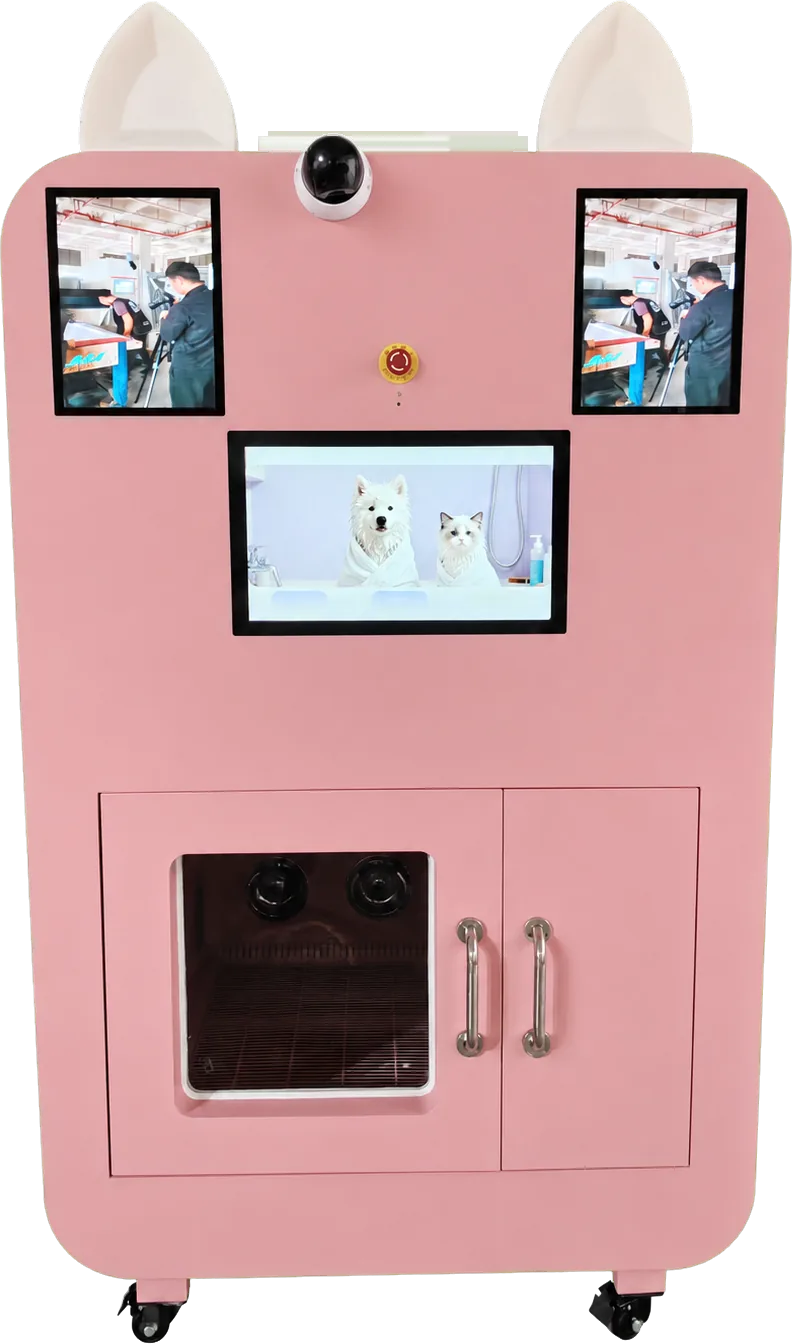
PetWash Max
Indoor or outdoorCaked mud on a working dog rarely gives up on the first pass. So the Max carries a second door — a manual bay with a constant-temperature water gun and dryer. Your team works the stubborn patches by hand once the automatic side finishes its seven steps. It's our flagship, and the only model that does both. Nayax reads more than 80 ways to pay.
See the Max →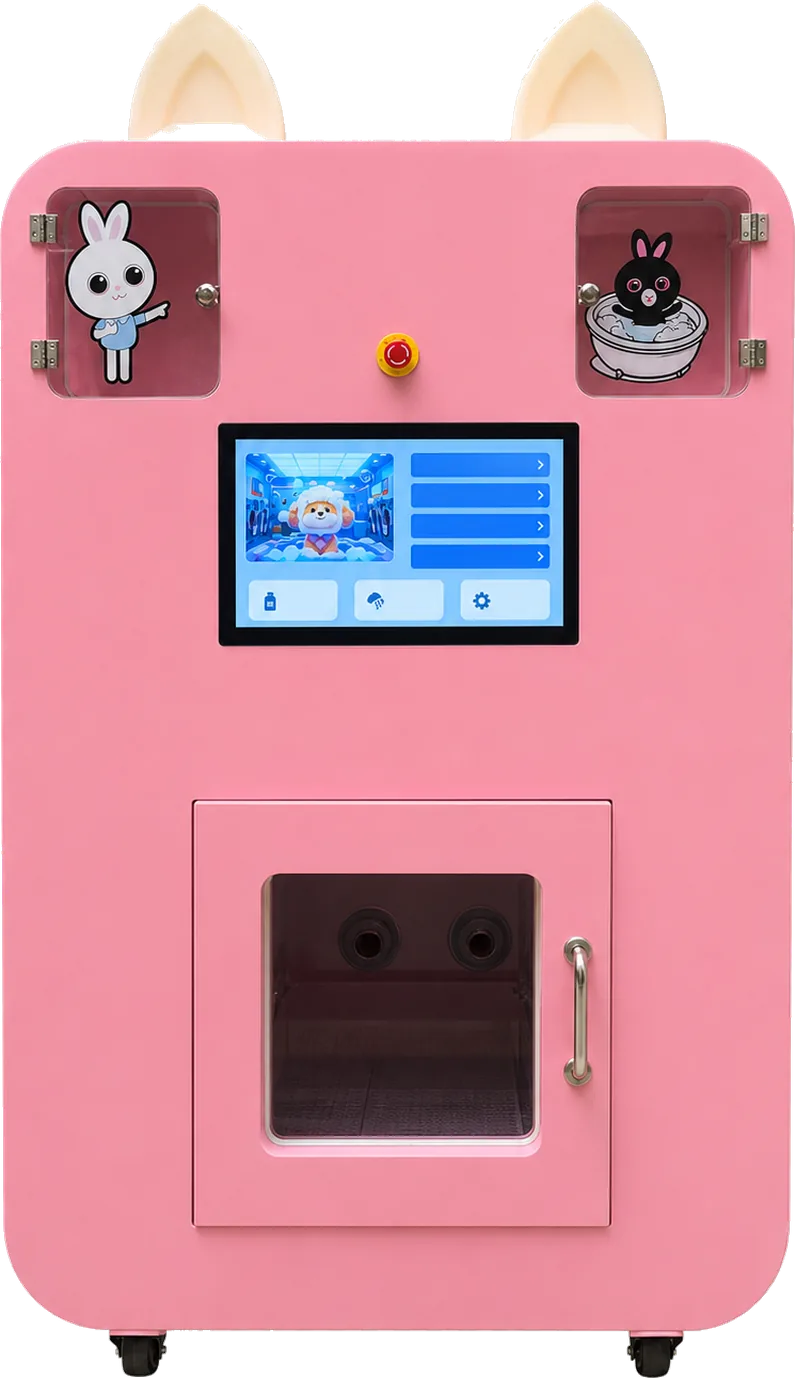
PetWash Pro
Indoor or outdoorWeatherproof steel cabinet, −10 °C to 55 °C — customers wash the working dog beside the truck.
See the Pro →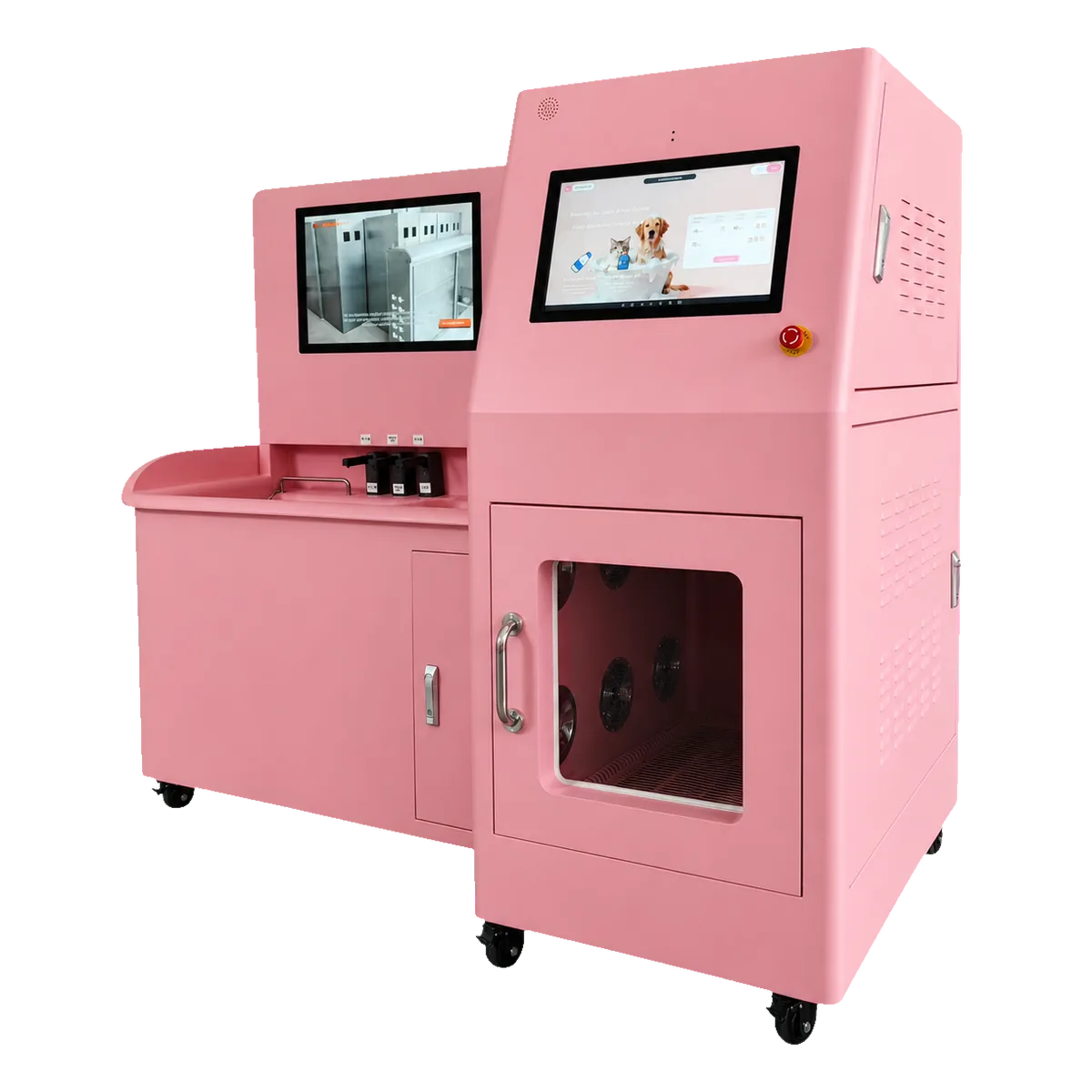
PetWash Tub
Indoor or outdoorWarm soak programs loosen caked mud from field dogs; the dry cabinet finishes the job.
See the Tub →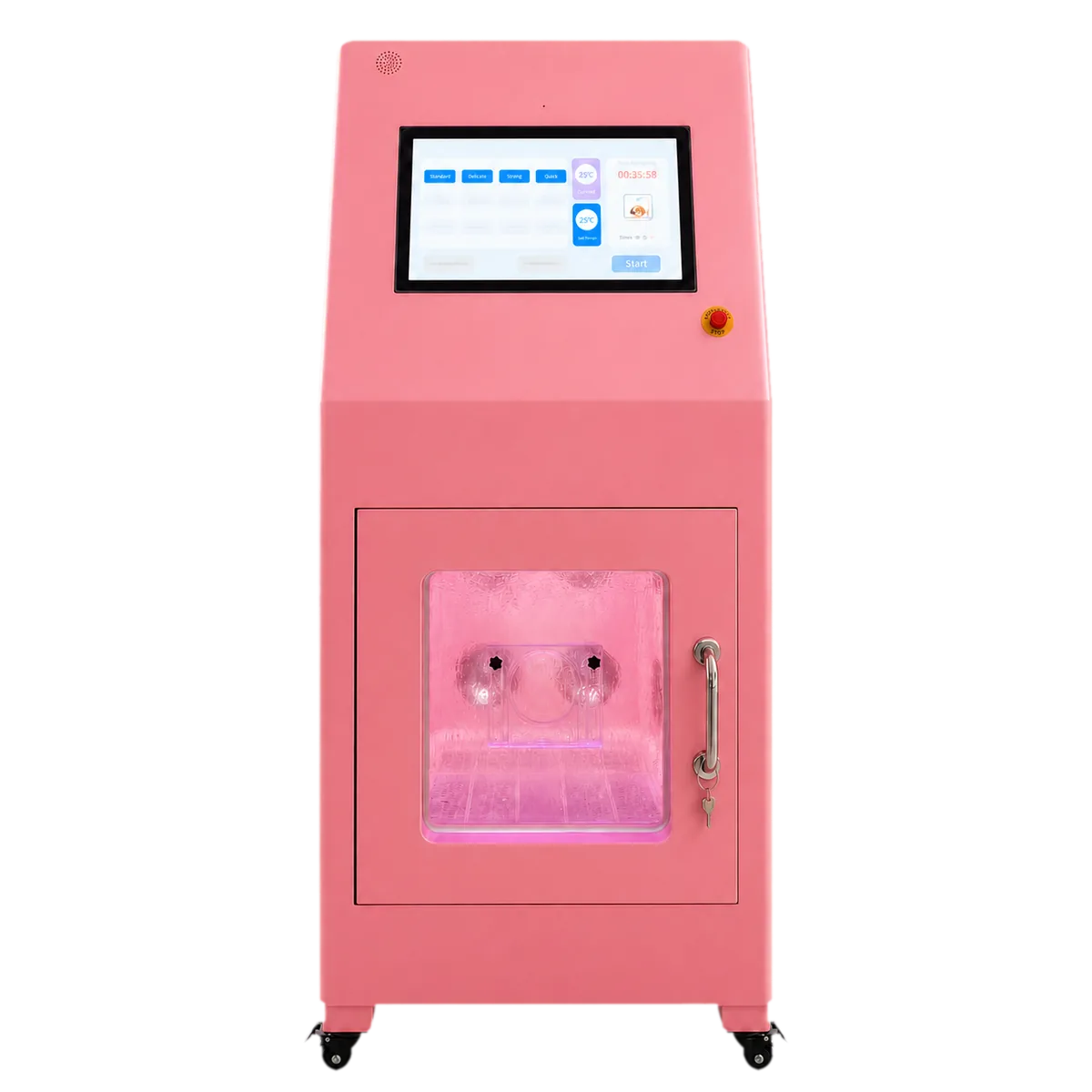
PetWash Store
Indoor or outdoor78 cm wide, so it tucks against a wall by the loading bay instead of eating aisle space. Weatherproof steel, full automatic, and it disinfects itself between animals.
See the Store →Utilities and Install for a Farm Store Pet Wash Station
Most feed store lots already have everything on the left. Check it before you order.
What your lot supplies
- Power: 220–240 V or 110–120 V, whichever your country uses. PetWash Max draws 4300 W; PetWash Tub 3200 W daily and 4000 W during a bath.
- Water: mains supply at 0.1–0.5 MPa. The machine heats it to 38 °C itself, so no hot feed is needed.
- Drain: a standard connection. Hair and solids are caught inside the machine, not in your line.
- Pad: about 1.2 m², level. PetWash Pro is 1190 × 1000 × 1900 mm and 350 kg.
- Weather: nothing to build. The weatherproof steel cabinet runs −10 °C to 55 °C in open air.
- Network: optional. It runs fine standalone; connect it and the free 12-function backend gives you a chain view across sites.
What ships with the machine
- CE (LVD + EMC) and RoHS certificates included with the order — the paperwork customs, your insurer and your landlord actually ask for.
- Nayax payments reader fitted as standard. Coins for the cash crowd, card and QR for everyone else.
- On-screen package and price setup — you set wash+dry and dry-only tiers by pet size, coat and time.
- Seasonal promo artwork for your lot signage.
- 1-year whole-machine warranty, plus lifetime maintenance.
- Lead time within 25 business days from order confirmation, shipped by sea or FedEx / DHL / UPS.
Our marks are CE (LVD + EMC) and RoHS. Outdoor models use a weatherproof steel cabinet, rated to operate from −10 °C to 55 °C. Ask for the full spec pack if your county wants documentation for a wastewater permit — the internal hair and waste water collection is usually the point that settles it.
Pet Wash Safety in an Unattended Farm Store Lot
A 70 kg livestock guardian in a closed cabin with nobody nearby — that is the fair fear. Here is every system that answers it.
Radar and infrared watch the whole wash
Millimeter-wave radar and infrared life detection track the pet through every step of the cycle. Nobody has to be in the lot for it to work.
Tracks every stepThe door unlocks if the pet stops registering
If the life signal drops for 30 seconds, the door releases on its own. No staff member, no key, no phone call.
30-second auto-unlockHeat is capped by a sensor, not a dial
An NTC cutoff kills power the moment water or air passes 42 °C. PID control holds the wash water at 38 °C ±2 °C the whole time.
42 °C cutoff · 38 °C ±2 °CA physical emergency stop
A physical stop button sits on the panel. The cabin is sealed but circulates fresh air, and the owner watches the whole wash through the window.
Physical button on the panelYour phone hears about it first
Abnormal events push an alert straight to the operator. You find out before your staff walk out to look.
Remote alert pushA clean cabin for the next dog
After every wash, not every shift, the cabin runs a four-minute automatic disinfection. Ozone and anion, infrared, and UV-C kill 99.9% of germs.
4 minutes · 99.9% of germsIf a part ever fails, you film the fault and our engineers diagnose it on a live video call. The replacement ships free with fitting instructions, and software updates install remotely. We have been in pet wash for over 10 years and run our own pet wash stores, so the fault list is one we have already lived through.
Certified for Export: CE, LVD, EMC & RoHS
You don’t have to worry about compliance. Every machine already meets CE, LVD, EMC, and RoHS standards, and we hand you the documents you need for customs, insurance, or your property manager.
CE certified
CE is the EU’s official conformity mark, and we include the certificates with your order for customs, insurers, and property managers.
LVD tested
LVD stands for the EU Low Voltage Directive, the electrical safety test that CE certification is built on. Tested to IEC 60335-2-75 with IEC 60335-1 — the standard written for commercial dispensing appliances.
EMC tested
It means the machine won’t cause electromagnetic interference with payment terminals or nearby equipment.
RoHS compliant
RoHS compliant means the machine is free of restricted hazardous substances, so it’s safe to import and operate. Assessed to EN IEC 63000:2018.
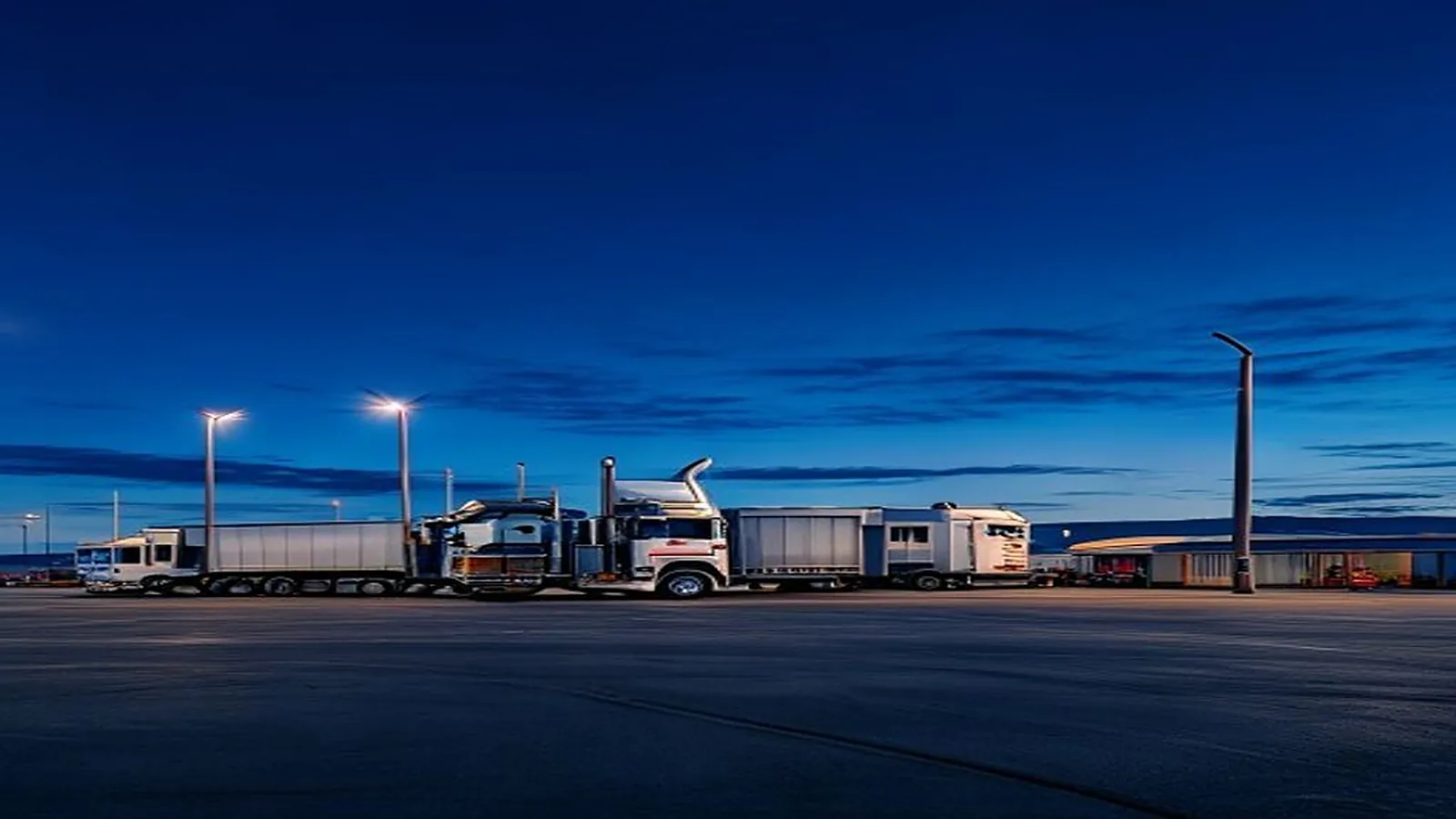
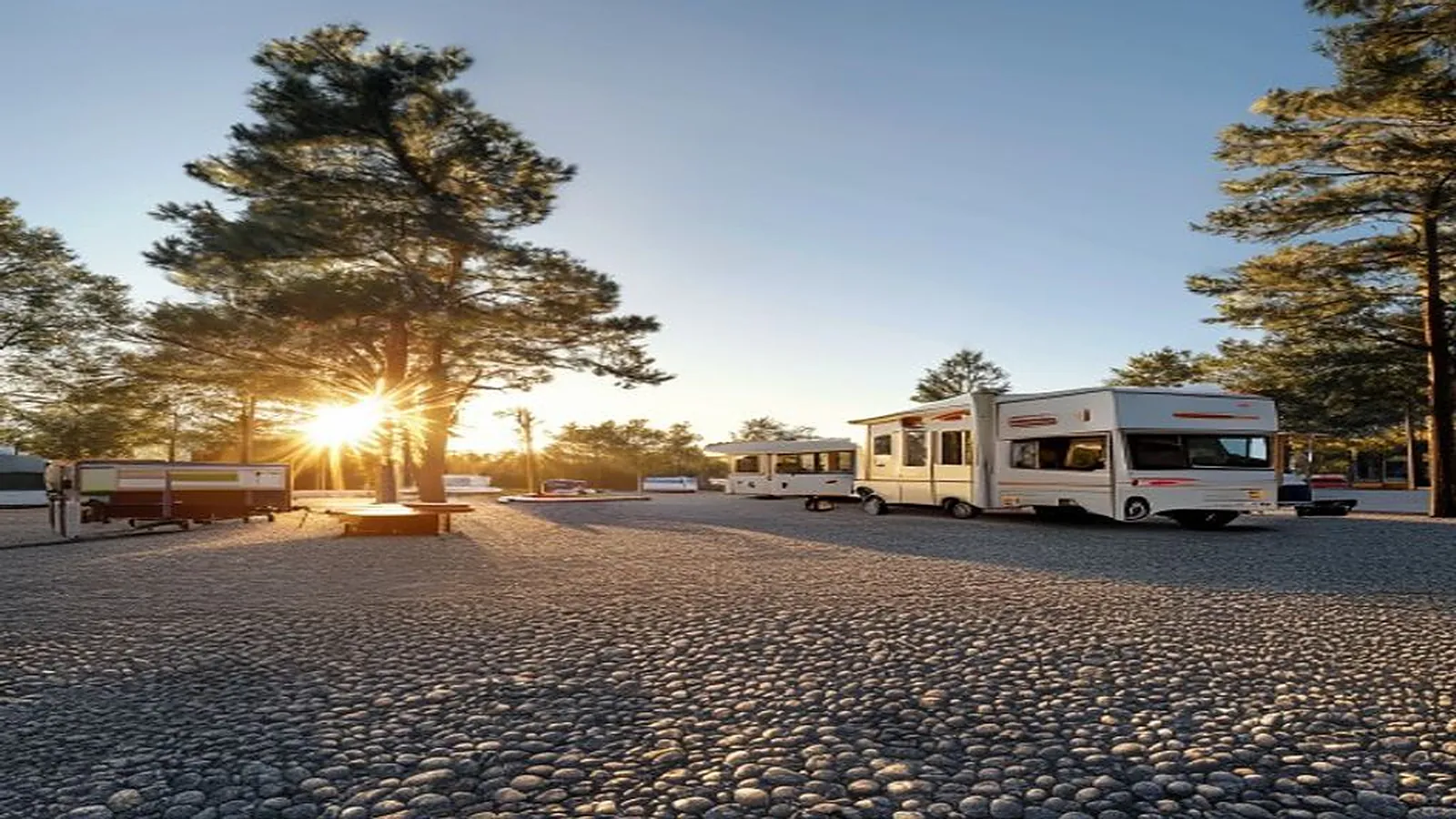
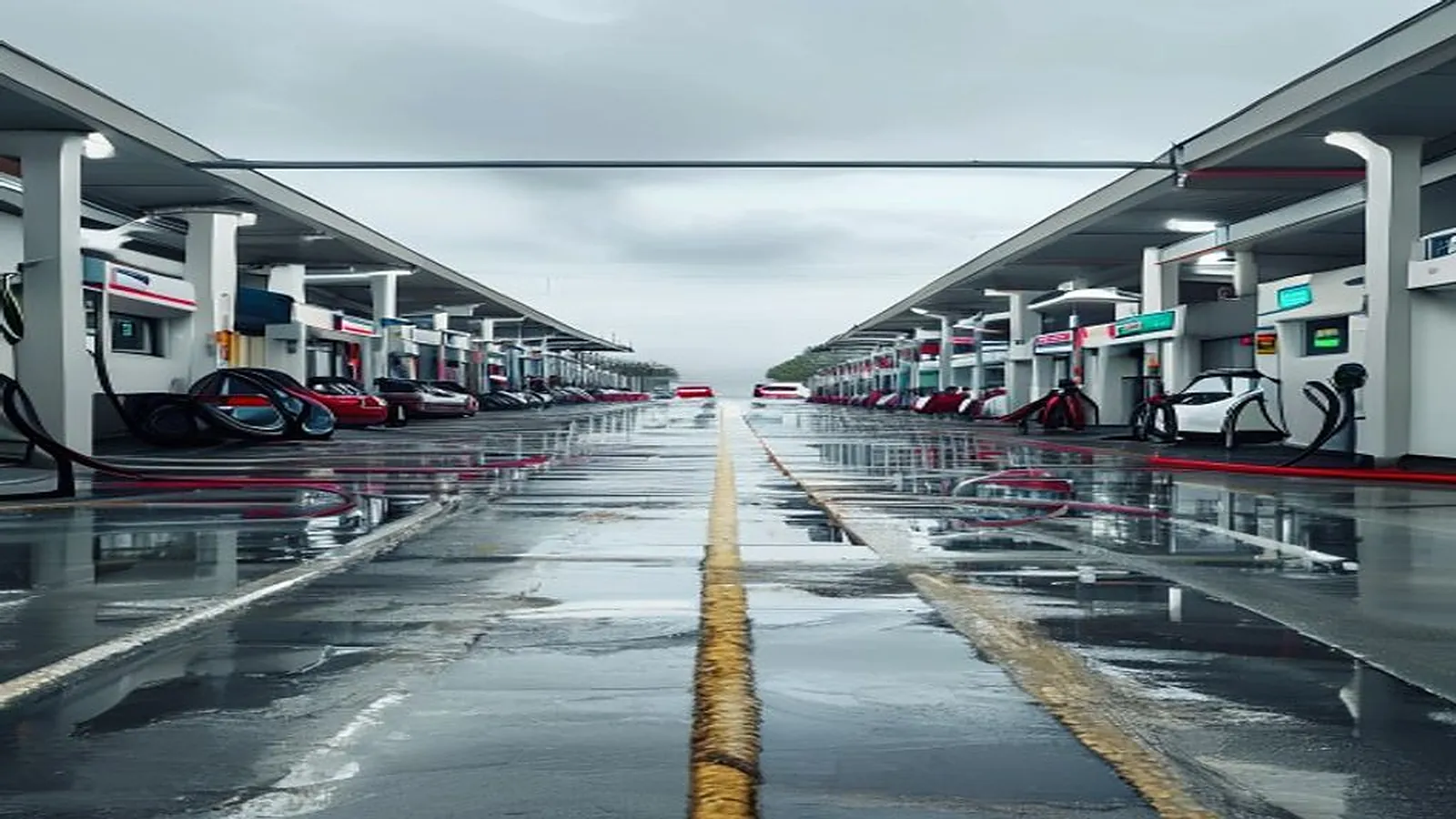
Where Else a Pet Wash Station Works
Put the Pet Wash Where the Trucks Park
Country and quantity are enough to price it. Both come back to you within 24 hours, along with a straight answer about how the cabinet handles your winter.
- Factory-direct price, no middleman
- Outdoor steel build for lot life
- 70 kg capacity for working breeds
- Seasonal promo artwork included
No spam. Your details are used only to prepare your quote.
Pet Wash for Farm Stores — FAQ
What rural retailers ask before adding one.
Do working dogs tolerate a machine wash?
Farm dogs are the machine’s easiest customers — habituated to equipment, motivated by warm water. The 70 kg capacity covers shepherds, cattle dogs, and LGD breeds, and the 38 °C constant temperature beats the yard hose by a country mile.
Where does a pet wash station install at a feed store?
A 1.2 m² pad in the parking lot or under the side canopy — wherever your store’s water, drain, and power reach. PetWash Pro's weatherproof steel cabinet needs no shelter at all.
Is there really demand for a pet wash in rural areas?
71.6% of US households own a pet (APPA) — and rural households skew higher still. The dogs work outside, and the nearest groomer is often 40 minutes away. You’re not competing with a salon; you’re competing with a cold hose.
Does a pet wash station drive store sales?
A wash visit is a store visit: dog food, fencing, work gloves. Dogs need washing every 4–6 weeks per AKC guidance — that’s a monthly trip to your lot with a trailer parked outside.
What is the lead time on a pet wash machine order?
Build time is 25 business days. Most rural stores ship by sea and time the arrival for spring, when the mud season and the wash traffic both start.
Why not just refer customers to the groomer in town?
Because that trip drives past your competitor's door. The average US groom is $60 (range $30–90, Dogster industry data) and needs an appointment; a machine wash at the $15–25 market price needs neither. Dogs need a bath every 4–6 weeks (AKC), so it is twelve trips a year you either keep in your lot or hand to someone 40 minutes away. 49% of consumers say they are more likely to visit a pet-friendly business (ICSC).
Doesn't pet hair clog a dog wash machine's drain? That's the failure everyone reports.
It is the number one complaint, and it comes from open tubs draining into the building line. Our machines collect hair and waste water internally on every cycle. Emptying the collection is routine service, not an emergency call-out, and your lot drains never see the hair. We supply the spec documents if your permit office wants them.
Does someone have to scrub it between dogs?
No. The enclosed cabin runs a 4-minute automatic disinfection after every wash: ozone and anion, infrared and UV-C, killing 99.9% of germs. Your team tops up consumables and empties the hair collection. That is the whole job. The open PetWash Tub is the staffed choice instead — it suits a grooming room where someone is already at the basin between pets.
What happens when the pet wash machine breaks and we're three hours from a city?
You're a long drive from any technician, so support doesn't need one. Hold your phone on the fault; our engineers read it live, ship the part free, and patch software remotely. We build these machines and we're pet wash operators ourselves, so answers come fast. A day down costs you wash trips and the feed sales riding on them.
Will the pet wash machine run through a hard winter?
The operating range is −10 °C to 55 °C in a weatherproof steel cabinet, no shelter required. If your lot regularly goes colder than that, a side canopy or a wall-adjacent pad solves it. Winter is often the best selling season anyway: the yard hose is frozen and the machine's water is 38 °C.