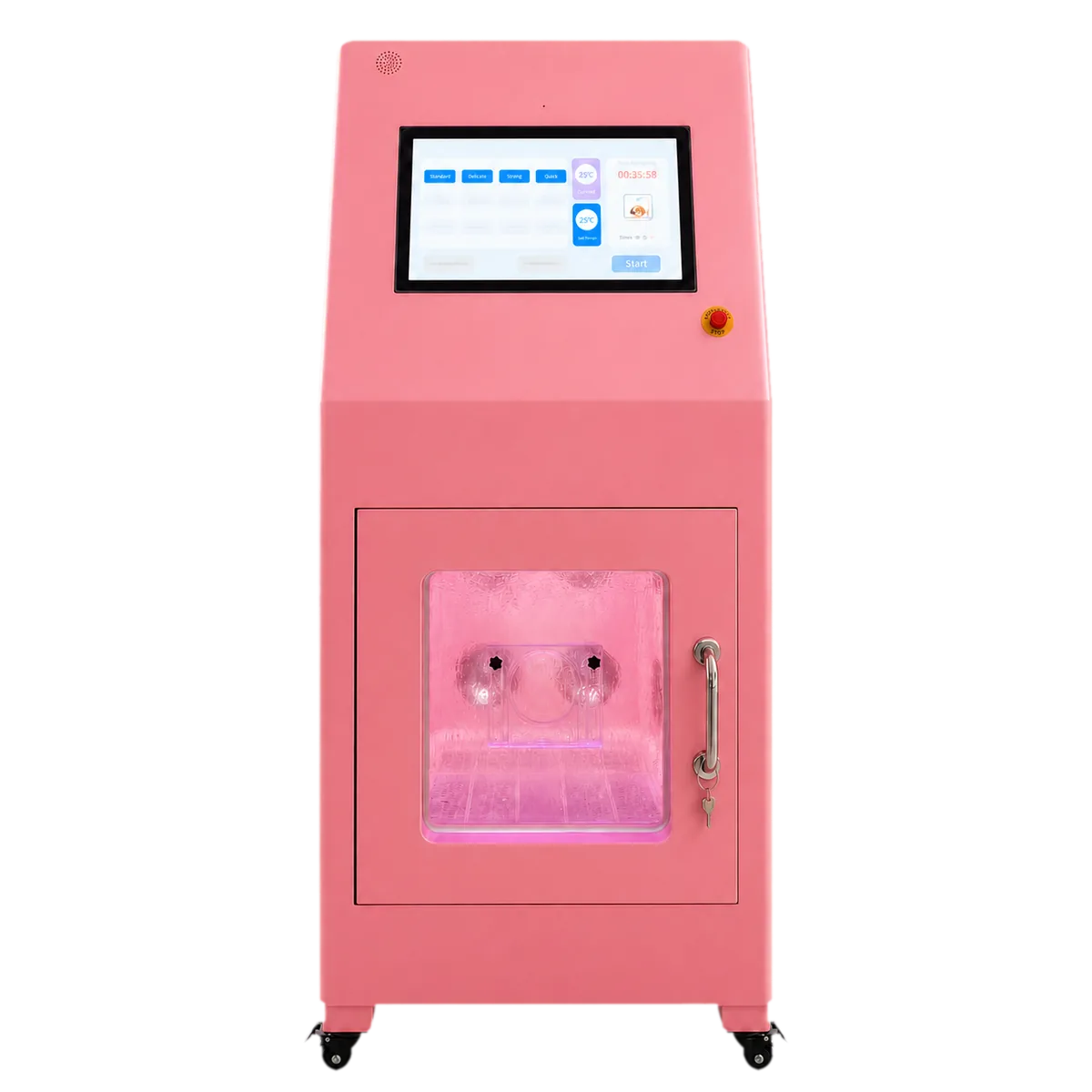
A Hygienic Pet Wash Station Built for Veterinary Clinics
Every bath in your clinic ties up a technician and a tub that someone must disinfect properly afterwards. This pet wash station does the bath, the dry, and the documented disinfection — while your team does medicine.
Just your email — we ask for the rest by reply.
We reply within 24 hours on business days.
Where a Pet Wash Station Fits in Clinic Infection Control
AAHA guidelines expect a written infection-control program, and the hand-scrubbed tub is its weakest paragraph. Here is the same job done two ways.
| The clinic tub today | The sealed wash cabin | |
|---|---|---|
| Disinfection runs after every single animal | ✕ depends on shift and workload | ✓ automatic, 4 minutes |
| Reaches a 99.9% germ kill every time | ✕ hand-scrubbed, result varies | ✓ ozone, infrared, UV-C |
| Hair and soil cleared before disinfectant runs | ✕ organic matter blocks disinfectant | ✓ extracted internally first |
| Keeps hair out of your floor drain | ✕ hair reaches your plumbing | ✓ collected internally every cycle |
| Every cycle logged for your written program | ✕ no cleaning record kept | ✓ machine-logged in the backend |
| Technician stays dry and hands-free | ✕ stands wet for every bath | ✓ loads in, takes out |
| Quiet enough to run beside a ward | ✕ hand dryers pass 100 dB | ✓ 65 dB or below |
This covers routine bathing of healthy animals. Sedated and post-op patients should stay hands-on in the open PetWash Tub.
Inside the 4-Minute Pet Wash Disinfection Cycle
Four minutes. Three methods. Nobody has to remember to start it.
Hair and waste water leave first
Disinfectant does not work on top of dirt. The machine pulls hair and waste water out of the cabin internally before the cycle begins, so nothing organic is left to soak up the treatment.
Every wash, automaticOzone and anion fill the cabin
Stage one floods the sealed cabin. It reaches what a cloth misses — corners, the underside of the grate, the door seal.
Stage 1 of 3Infrared runs across the surfaces
Stage two of the same four-minute cycle. No one has to start it, time it, or initial a sheet for it.
Stage 2 of 3UV-C closes the cycle
Stage three finishes at a 99.9% germ kill. The next patient walks into a cabin that was treated four minutes ago — not one that was wiped down at the start of the shift.
Stage 3 of 3 · 99.9% of germsThe Pet Bathing Demand Your Clinic Already Sees
Bathing is not a side request. It is a standing need attached to every patient on your books.
Your clients are already paying for baths somewhere. The only question is whether it happens under your roof or across town.
What a Pet Wash Station Frees Your Clinic Team to Do
The bath is 30 unattended minutes. Here’s where those minutes go instead.
Technician hours back on medicine
Routine baths, pre-procedure washes, and go-home clean-ups run in the machine while your team handles patients that need hands.
30 min unattended per bathCross-contamination controlled
The cabin seals during the wash and disinfects after it. No shared tub surface carrying the last patient to the next one.
Sealed cabin · kills 99.9% of germsNo toxic fragrance — a medical choice
Scent sprays and essential oils stress patients and harm cats’ livers and kidneys, so we skip them entirely. The gentle shampoo itself leaves a light, fresh scent — patients go home healthy and smelling clean.
Cat-safe by designA client service, if you want it
Open the station to clients — post-op-cleared baths, arthritic owners, walk-ins — with Nayax payment covering consumables.
Optional revenuePet Wash Wording for Your Infection-Control Protocol
Wording your infection-control officer can adapt for the written program:
We supply the certificate pack (CE — LVD + EMC — and RoHS), cycle specifications, and drainage and utility requirements for your records and your installer.
What a Pet Wash Station Saves in Technician Hours
A clinic does not buy this to earn coins. It buys back the hours a licensed technician spends standing wet. Here is the math on a clinic that bathes ten pets a week.
Ten baths a week is a small clinic. Twenty doubles every line above.
Loading and unloading is the only hands-on part. A kennel assistant can do it instead of a licensed technician.
Run it free for post-op and senior patients, or charge for it. Nayax payment is already fitted to every self-serve model.
Owners can run a pre-surgery bath themselves the day before. That hour never touches a treatment room.
Multiply the saved hours by your own technician wage and the table gives you your own figure. The ranges come from published operator reports. On price: send us your country and how many machines you need. Buying factory-direct removes the trader margin, and your exact price comes with the quote within 24 hours.
Pet Wash Station Utilities, Space, and Install Requirements
Before you take this to your practice owner, here is exactly what the room needs and exactly what arrives in the crate.
What the room needs
- Power: 220–240 V or 110–120 V, whichever your country uses. 4300 W for the Max, 3200–4000 W for the Tub.
- A normal wall socket is enough for the PetWash Mini — 1870W, no electrical work, no new circuit.
- Water: a mains supply at 0.1–0.5 MPa. The machine heats it to 38 °C ± 2 °C itself.
- Drain: a standard floor or wall drain. Hair and solids are caught inside the machine before anything reaches it.
- Floor space: from 780 × 1200 mm for the Store, up to 1190 × 1000 mm for the Pro and Max.
- Floor loading: 81 kg for the Mini up to 366 kg for the Max — worth checking on a suspended floor.
- Room temperature: anywhere from −10 °C to 55 °C.
- Running cost: 2–2.5 kWh and 0.09–0.11 m³ of water per wash.
What ships with the machine
- CE certificates (LVD + EMC) and RoHS — for customs, your insurer, and your landlord.
- Drainage and utility spec sheets for your installer and for any permit application.
- Cycle specifications you can file with your infection-control program.
- 1-year whole machine, plus lifetime maintenance.
- Nayax payment terminal fitted, in case you ever open the station to clients.
- Lead time within 25 business days, shipped by sea or by FedEx, DHL, or UPS.
- OEM options if you want the panel, color, logo, or screen language to match your clinic.
- Software updates that install remotely — no service visit.
We hold CE (LVD + EMC) and RoHS.
Picking the Right Pet Wash Machine for a Clinic
One earns in the waiting room, one lives in the cat ward.
PetWash Max
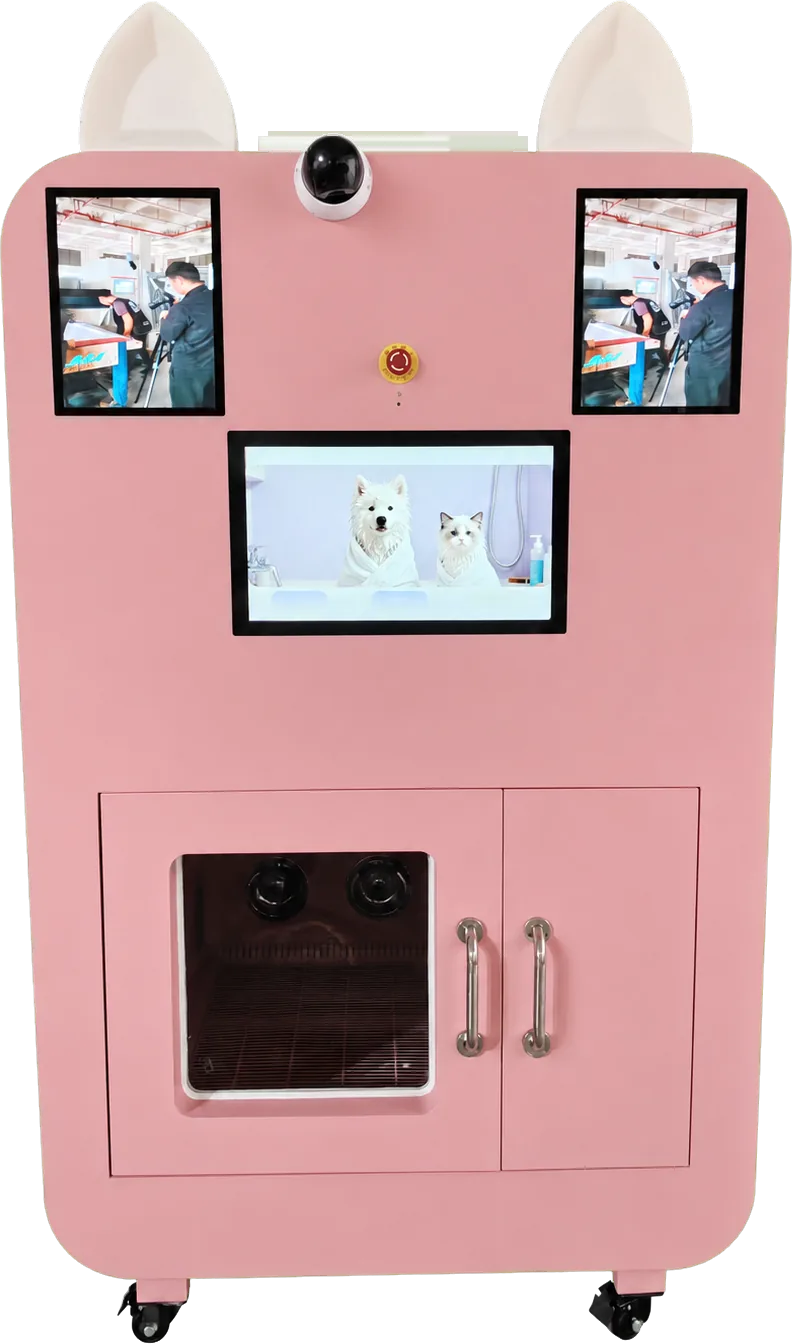
Indoor or outdoorSome patients need hands on them once the machine is done. That's the Max's second door: a manual bay with a constant-temperature water gun and dryer, ready the moment a technician takes over. The first door runs the whole automatic bath, wash through dry, for dogs and cats to 70 kg. It's the top of our range, and the only model that does both.
See the Max →PetWash Store
IndoorOnly 78 cm wide — a self-serve dog & cat wash clients pay for while you handle medicine.
See the Store →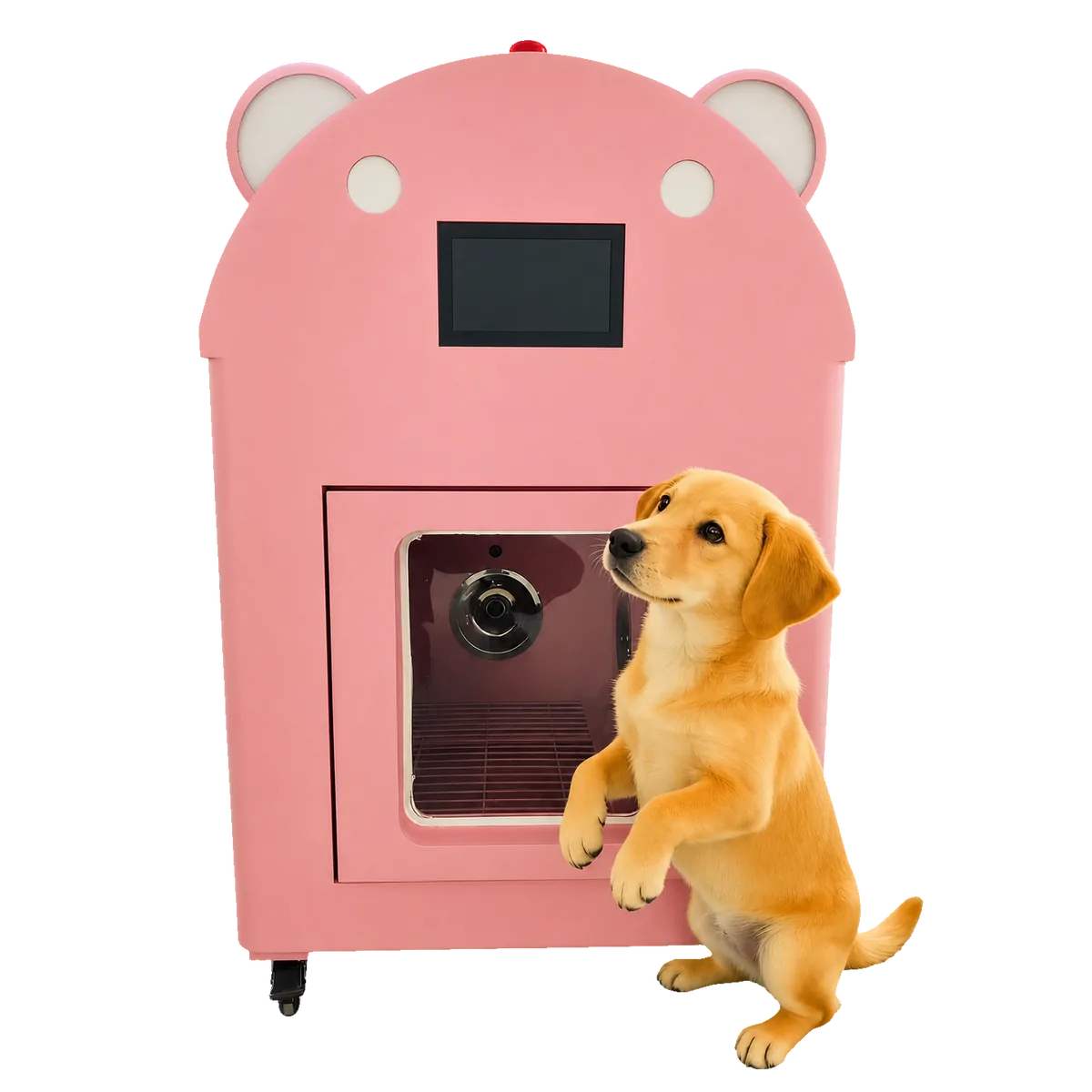
PetWash Mini
IndoorCat-first to 15 kg, quiet drying, normal socket — no perfume sprays, just a light fresh scent.
See the Mini →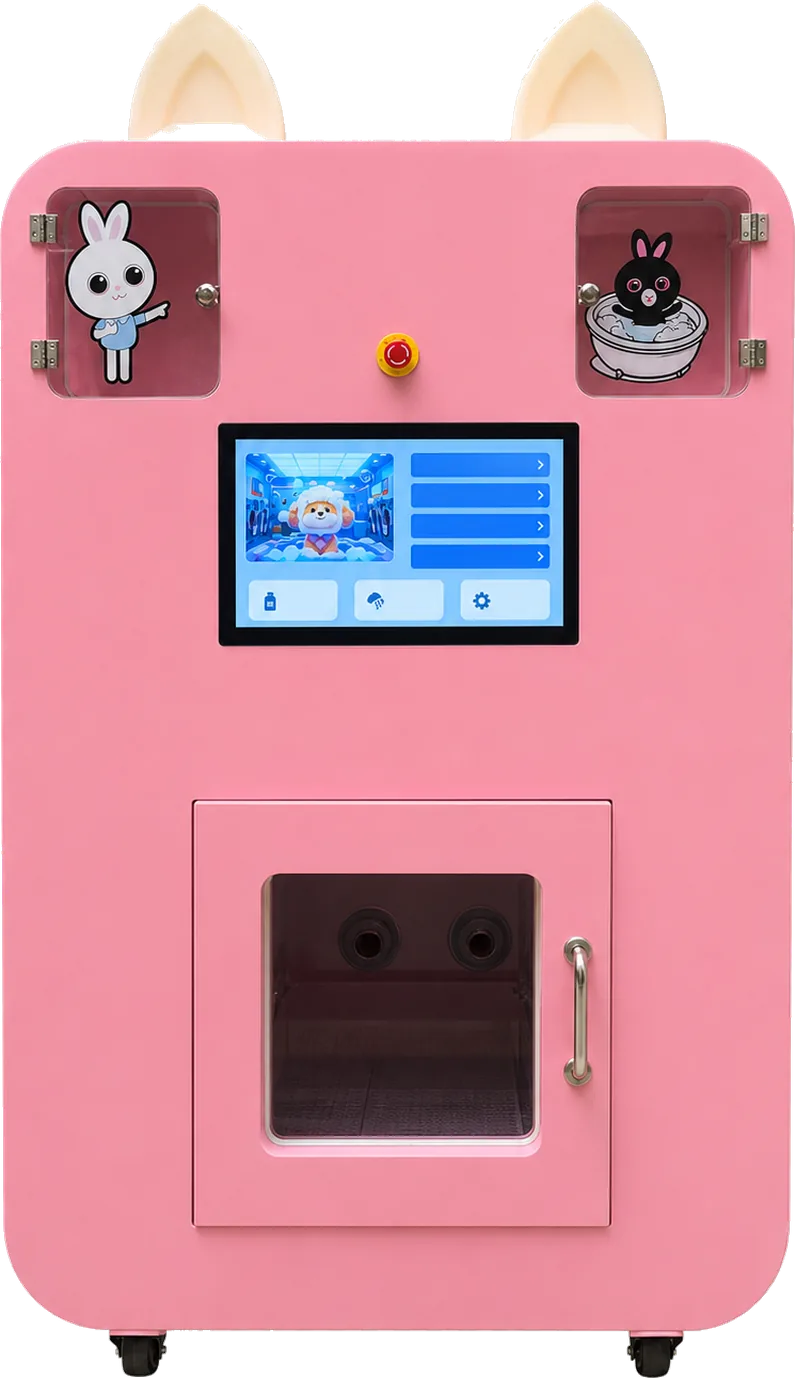
PetWash Pro
Indoor or outdoorThe same large automatic cabin as the Max, with one door. The steel cabinet is rated -10 C to 55 C, so it can live in a covered yard and keep clinic floor space free.
See the Pro →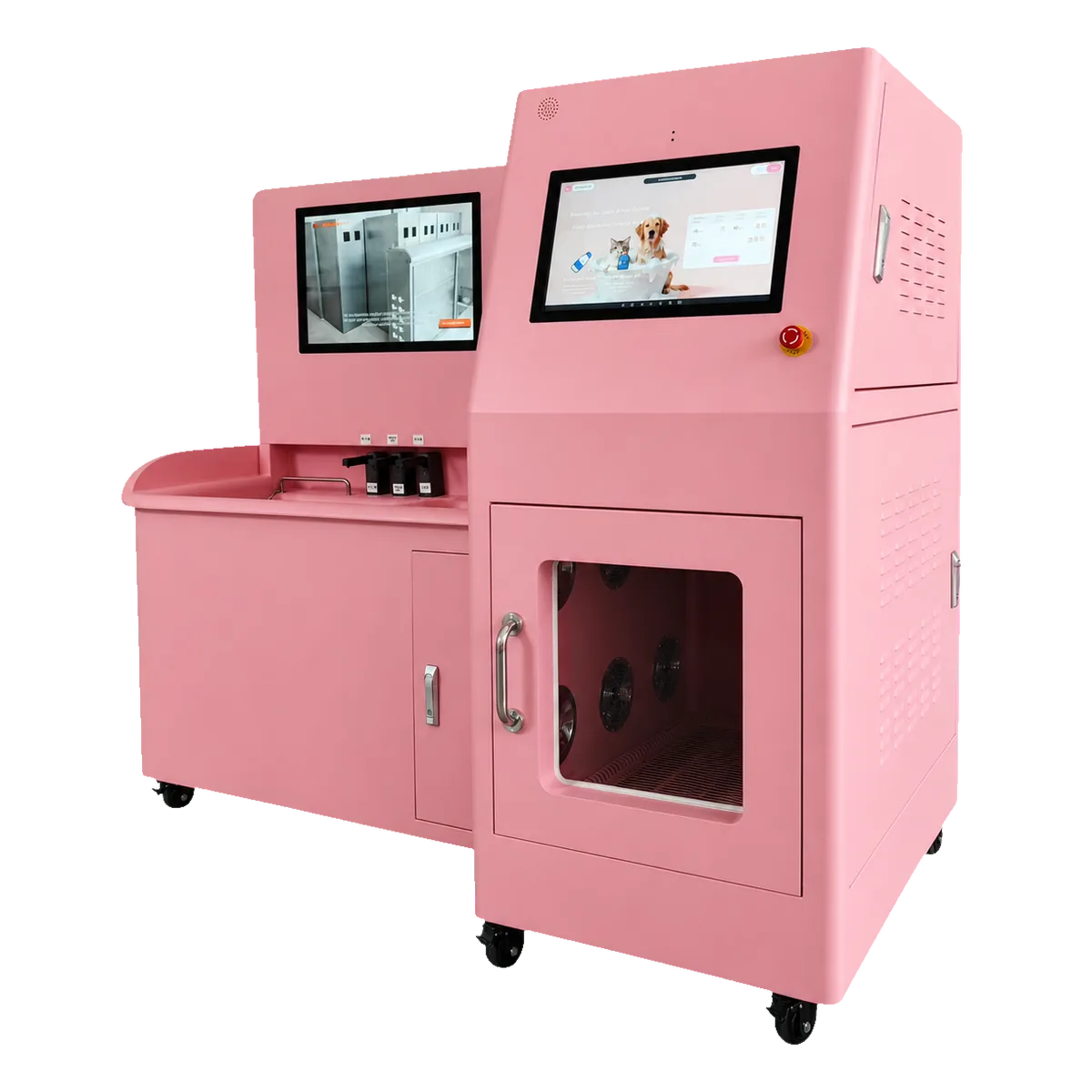
PetWash Tub
Indoor or outdoorFor medicated and post-op baths a nurse has to control herself. Open bath, four labelled taps, and a separate drying cabinet so the next animal starts straight away. Soak baths are included, which no sealed cabin offers.
See the Tub →Pet Safety and Liability Inside an Automatic Pet Wash Cabin
Your clinic carries the liability for every animal on the premises. So the cabin is built to fail open, never shut.
Life detection watches the whole cycle
Millimeter-wave radar and infrared sensors track the animal from the first step to the last. Nothing depends on someone remembering to look in.
Radar + infrared, every cycleThe door fails open, never shut
If the sensors lose the signal for 30 seconds, the door unlocks on its own. Nobody has to find a key, a code, or the one person who knows the override.
Auto-unlock after 30 secondsTemperature is capped twice
A PID loop holds the water at 38 °C ± 2 °C for the whole wash. A separate NTC cutoff kills power if water or air passes 42 °C. It stops outright rather than throttling.
38 °C ± 2 °C · 42 °C hard cutoffQuiet drying keeps patients calm
Drying stays at or below 65 dB, while rival machines often run past 100 dB. That is the point where a dog stops tolerating the box and starts fighting it.
65 dB or belowA stop button and a phone alert
A physical emergency-stop button sits on the panel, within reach of whoever is standing there. Abnormal events also push an alert to the operator's phone.
On-panel stop · remote alertSealed wash, fresh air, full view
The cabin seals during the wash and still circulates fresh air throughout. The owner or your technician can watch the entire cycle through the window.
Window view, start to finishMachine bathing is for healthy animals. For sedated, post-op, or fragile patients, keep your team hands-on — the PetWash Tub gives them an open 38 °C basin with a separate drying cabinet.
Certified for Export: CE, LVD, EMC & RoHS
You don’t have to worry about compliance. Every machine already meets CE, LVD, EMC, and RoHS standards, and we hand you the documents you need for customs, insurance, or your property manager.
CE certified
CE is the EU’s official conformity mark, and we include the certificates with your order for customs, insurers, and property managers.
LVD tested
LVD stands for the EU Low Voltage Directive, the electrical safety test that CE certification is built on. Tested to IEC 60335-2-75 with IEC 60335-1 — the standard written for commercial dispensing appliances.
EMC tested
It means the machine won’t cause electromagnetic interference with payment terminals or nearby equipment.
RoHS compliant
RoHS compliant means the machine is free of restricted hazardous substances, so it’s safe to import and operate. Assessed to EN IEC 63000:2018.
Where Else a Pet Wash Station Works
Get a Pet Wash Station Quote — Give Your Technicians Their Hours Back
Give us your country and a unit count. Within 24 hours you will have pricing, a recommendation, and the certificate list for your infection-control records.
- Factory-direct price, no middleman
- Tub for hands-on control, automatic for routine baths
- Certificates ready for your infection-control records
- Honest advice — if a tub suits you better, we’ll say so
No spam. Your details are used only to prepare your quote.
Pet Wash for Veterinary Clinics — FAQ
What practice managers ask before adding bathing equipment to their clinic.
How does a pet wash machine fit our infection-control protocol?
As a documented step. AAHA guidelines call for written infection-control programs; the machine runs ozone, infrared, and UV-C for 4 minutes after every animal and collects hair and waste water internally. That’s a repeatable, loggable disinfection cycle — not a “technician wiped the tub” note.
Can staff control the wash hands-on?
Yes — choose the PetWash Tub, our self-serve open tub: an open 38 °C tub for hands-on washing plus a separate drying cabinet.
Is machine washing safe for sedated or recovering patients?
Machine bathing is for healthy pets. For patients, the Tub’s open basin keeps your team hands-on and in full control with constant-temperature water. The automatic cabin’s radar and infrared sensors monitor vital signs and unlock after 30 seconds without a signal. For healthy pets in the automatic cabin, the sensors, the 42 °C cutoff, and the stop button keep the chance of injury very low, and the CE (LVD + EMC) and RoHS certificates ship with every machine.
Does pre-procedure bathing help?
Bathing before surgery can reduce skin bacteria when done at least 12 hours prior. A self-serve station lets owners handle that at drop-off the day before — without using a treatment room or a technician’s hour.
Can a clinic pet wash station also earn revenue?
Many clinics run the station for clients: post-op-cleared baths, seniors who can’t lift their dog into a tub, or simply walk-ins. At 100–200 washes a month, clinics typically see $12,000–24,000 a year, against $1.20–3.50 in consumables per wash. Nayax payment is built into every self-serve model.
What does a pet wash station cost for a clinic?
Practice managers ask who actually picks up when a machine goes down. Our own engineers do — the same people who wrote its software. Film what's wrong, get an engineer on a video call, and the part goes out at our cost. The whole machine is covered for a year, and our support doesn't end with the warranty. On price, give us a country and a machine count; the figure lands within 24 hours.
Will pet hair clog our clinic drains?
No, and this is the failure operators report most often with open tubs. Hair and waste water are collected inside the machine every single cycle, before anything reaches your plumbing. Emptying the collector is part of routine cleaning — a few minutes, not a plumber.
How many pets can we bathe in a day?
A wash and dry runs about 30 minutes for a small dog, and the disinfection cycle adds 4 minutes on top. That is roughly 14 pets in an eight-hour day, hands-free. Large or thick-coated dogs take longer, and the operator sets the time tiers on screen.
Is pet wash machine noise a problem next to a ward?
Drying stays at or below 65 dB. Many competing machines run above 100 dB. That difference is why the station can sit near recovery or boarding without unsettling the animals already in the building.
What happens if the pet wash machine breaks and you are on the other side of the world?
A clinic schedules baths into the day, so a stopped machine lands back on technician hours. Show us the fault on video; the people who built the cabin read it live and send the replacement part at no charge. Software problems get patched from our end. We hit the same faults in our own wash stores, so diagnosis is rarely guesswork.
Do we need a wastewater permit for a pet wash station?
Rules differ by city, so check locally. What helps your application is that hair and waste water are collected internally rather than flushed to drain, and we supply the drainage and utility specification documents your installer or permitting office will ask for.