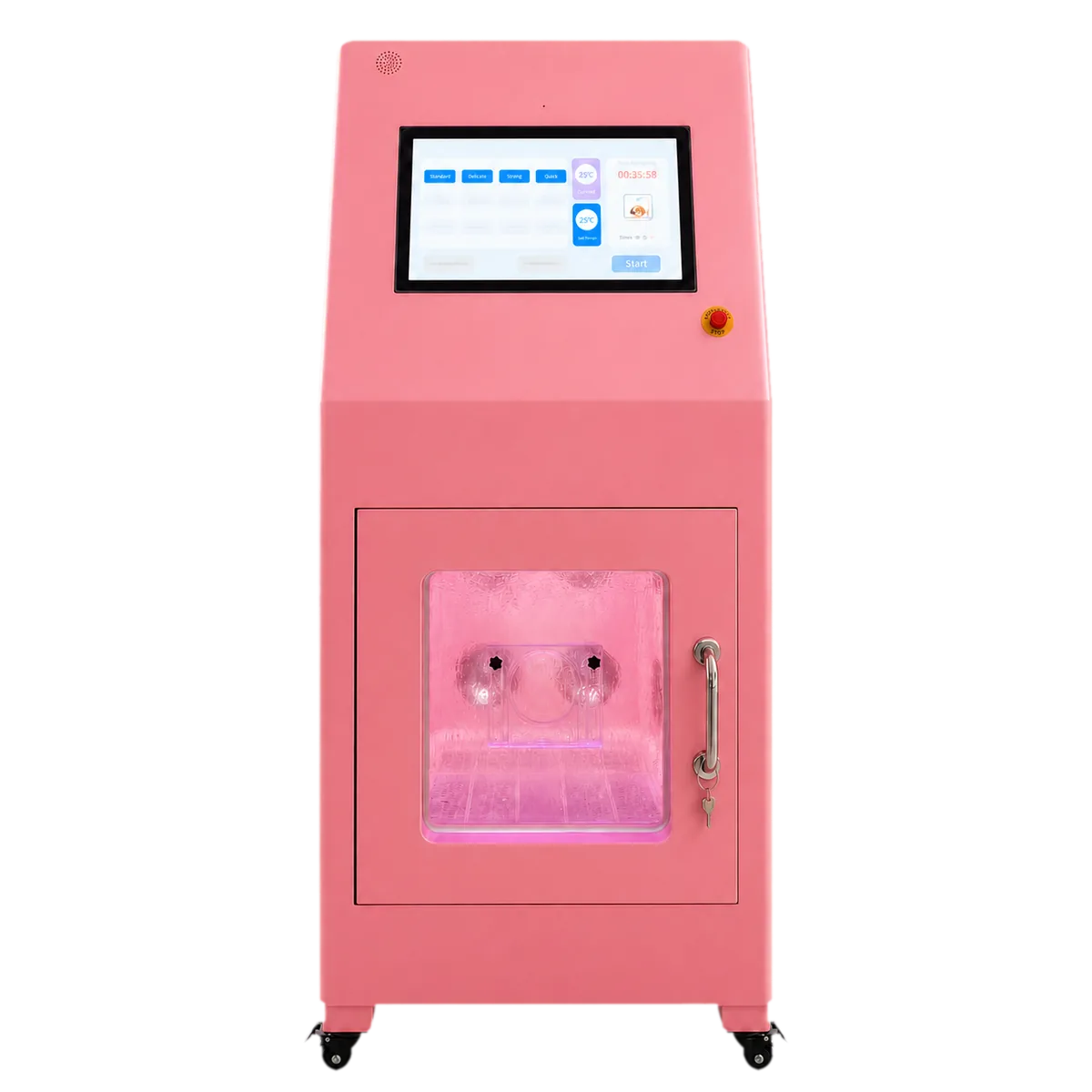
The Pet Wash Station That Keeps Shoppers at Your Center Longer
Shopping centers are going dog-friendly because the numbers say to: 28% of owners bring the dog shopping, and pet amenities pull measurable traffic. A pet wash is the amenity that turns a quick errand into a longer visit.
Just your email — we ask for the rest by reply.
We reply within 24 hours on business days.
Two Ways a Shopping Center Runs a Pet Wash
Amenity or profit center — the machine doesn’t care; your strategy decides.
Center-operated amenity
- Marketed as a property feature: “dog-friendly, with a pet spa”
- Free or low-cost — dwell time is the return
- Backed by your center branding on the cabinet
- One more line in the leasing brochure your competitors lack
Tenant- or kiosk-operated
- Your pet-store tenant runs it as a traffic driver
- Or lease the pad like any kiosk — the operator collects washes
- Nayax payment revenue, monitored remotely — 100 washes a month at $10 is $12,000 a year
- Zero operational load on property staff
The Numbers Behind a Pet Wash Amenity in Shopping Centers
Leasing teams want the demand proof before the site plan. Four numbers do most of the work.
Add the base underneath: 71.6% of US households own a pet — 95 million households — and 53% own a dog (APPA). 28% of owners bring the dog shopping (Rover). A professional groom in the US averages $60, which is why a $15–$25 self-serve wash converts.
What a Pet Wash Kiosk Earns in a Shopping Center
Footfall only counts once you put a price on it. Here is the kiosk modelled as a revenue line instead of an amenity line.
Charge pad rent like any other kiosk and carry no risk. Take a revenue share and ride the upside. Or run it yourself and keep all of it. The machine is identical — only the lease structure changes.
Thirteen square feet of common area: a corridor end, a nook by the restrooms, a vacant-unit doorway, or a parking-field island. No GLA is converted and no tenant is displaced.
A wash and dry runs about 30 minutes. That is 30 minutes the shopper stays instead of driving home — and 49% of consumers say they are more likely to visit a pet-friendly business (ICSC).
Hand the pad to the pet store, groomer, or vet you already lease to and it becomes their traffic driver. Their sales report improves, and so does the renewal conversation.
Dogs need a bath every 4–6 weeks (AKC). That is a monthly visit you never had to market, from a shopper who now has a reason to pick your center over the one down the road.
A worked example — your footfall, your price, and local costs set the real figure. The ranges come from published operator reports: one puts the average machine at about $17,000 a year, and another states $15,000 average annual profit per unit with a 12–24 month payback. Buying factory-direct removes the trader margin, and your exact pricing comes with the quote within 24 hours.
Installing a Pet Wash Station in an Existing Shopping Center
The revenue works. Now the retrofit question — and it is smaller than a tenant fit-out. A kiosk pad and three hookups, no wet room, no demolition.
What the site has to provide
- 1.2 m² of level floor — a concourse nook, corridor end, vacant-unit doorway, or parking island
- A water tee-off at 0.1–0.5 MPa — a standard washroom supply is enough
- A drain connection — hair and waste water are collected inside the machine first, so nothing loads your common-area drains
- 220–240 V or 110–120 V power, whichever your country uses — up to 4300 W at peak on the PetWash Max
- Wi-Fi or a SIM for payments, price changes, and remote monitoring
- No dedicated circuit available? The PetWash Mini runs on a normal wall socket at 1870 W
What we put in your property file
- Dimensioned machine drawings with every measurement you need
- CE (LVD + EMC) and RoHS certificates — supplied with the order for customs, your insurer, and the tenant file
- Spec sheets for the plumbing and wastewater sign-off
- Voltage and payment terminal set for your country — Nayax with 80+ payment channels on every self-serve model
- Center branding on the cabinet, approved on a proof before we build
- Remote onboarding — packages and prices set from a phone, software updates install over the air
Running load is small and predictable: 2–2.5 kWh and 0.09–0.11 m³ of water per wash (the Mini is about 2 kWh and 0.09 m³). Useful when you are deciding whether the kiosk sits on a CAM recharge or its own sub-meter. Outdoor placements use the weatherproof steel cabinet of the PetWash Pro, rated −10 °C to 55 °C.
Pet Wash Safety and Liability in a Public Concourse
A machine in common area gets used by strangers, late in the trading day, sometimes with children watching. Six things stop that from turning into a claim.
Sensors watch the pet, not just the owner
Millimeter-wave radar and infrared track movement and vital signs for the whole cycle. If the signal drops for 30 seconds, the door unlocks by itself.
30-second auto-unlockWater and air cannot run hot
The wash holds 38 °C ±2 °C under PID control. An NTC cutoff kills power if water or air passes 42 °C. Drying stays at 65 dB or less, so it does not carry down the concourse the way rival dryers do at over 100 dB.
38 °C ±2 · 42 °C cutoff · ≤65 dBA stop button anyone can reach
A physical emergency-stop button sits on the panel. The owner stands at the window for the whole cycle and can end it at any moment.
Panel-mounted e-stopNo wet floor in your common area
The cabin is sealed with fresh-air circulation. Hair and waste water are collected inside after every wash, and the pet walks out dry — so there is no puddle, no shake-off, and no slip risk on your floors.
Sealed cabin · dry exitFaults reach a phone, not your security desk
Abnormal events push an alert to whoever runs the machine. Software fixes install remotely, so nobody is opening a panel in the middle of trading hours.
Push alerts · remote updatesThe paperwork your insurer asks for
CE (LVD + EMC) and RoHS certificates ship with the order — for customs, for your insurer, and for the tenant file. Every wash also ends with a 4-minute ozone, infrared, and UV-C disinfection that kills 99.9% of germs, run automatically before the next pet goes in.
CE (LVD + EMC) · RoHSPicking the Right Pet Wash Machine for a Shopping Center
Corridor, parking field, or flagship court — one fits each.
PetWash Store
IndoorOnly 78 cm wide — a full automatic pet wash in a corridor or vacant-unit slot.
See the Store →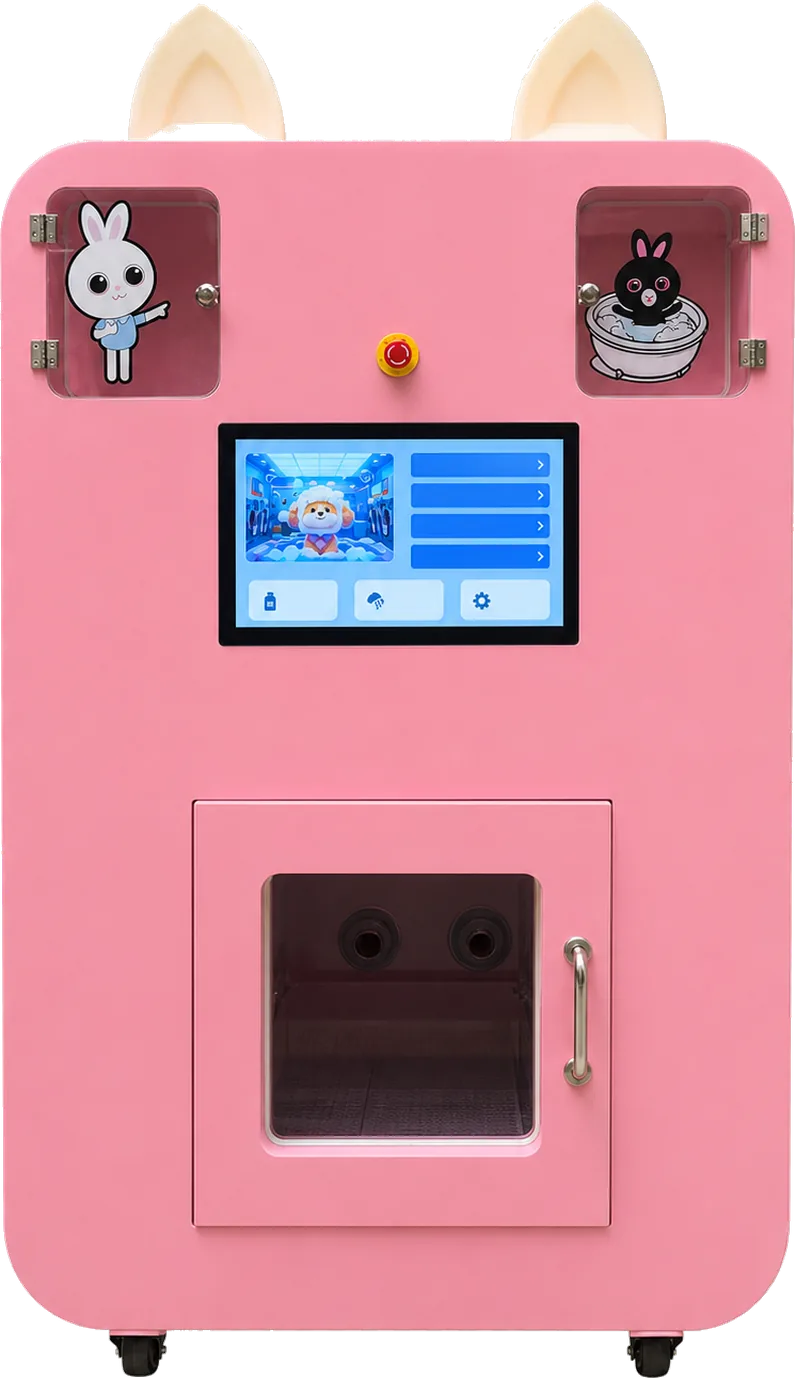
PetWash Pro
Indoor or outdoorWeatherproof steel cabinet by the cart returns — shoppers wash the dog after errands.
See the Pro →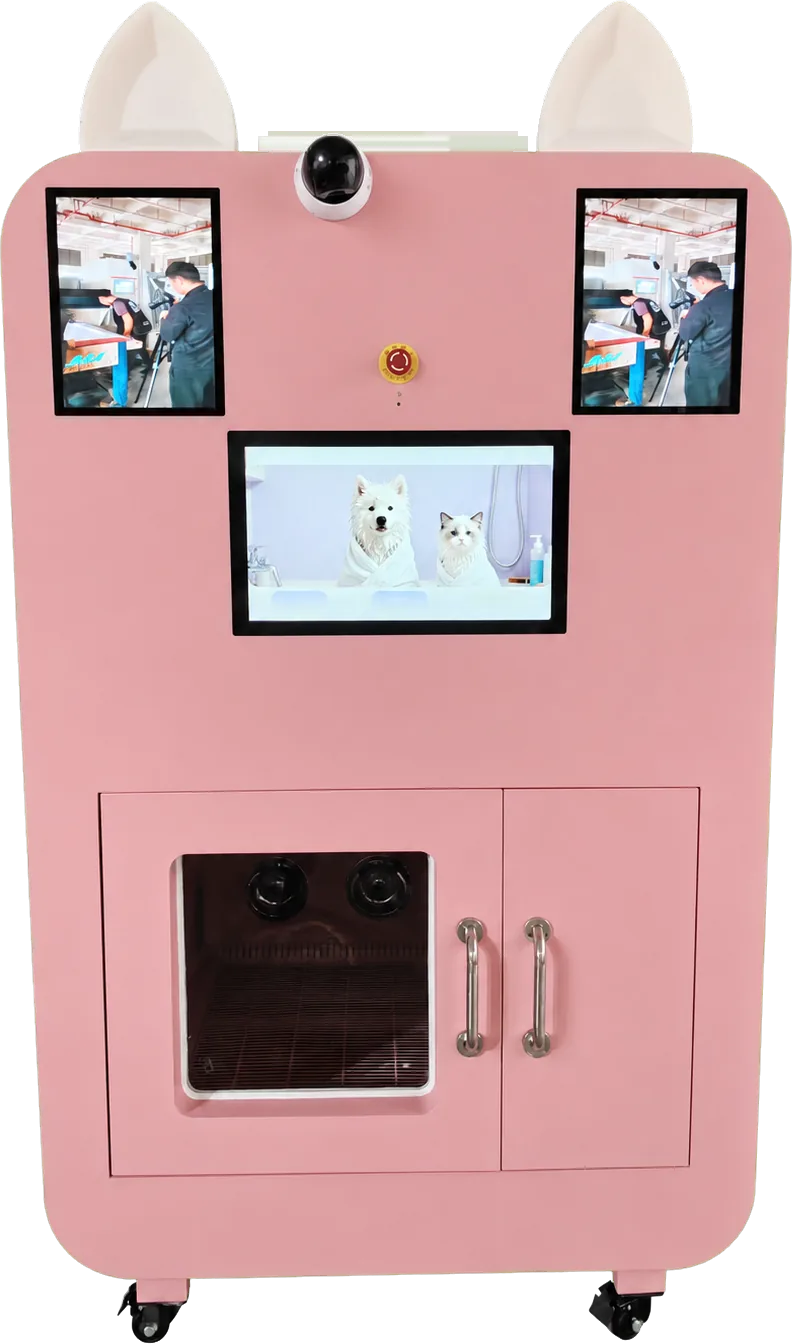
PetWash Max
Indoor or outdoorA pet wash on a main concourse has to read as an amenity, not a vending box. The Max does, right down to its three screens. It's also the flagship, and the only model that adds manual tools to the automatic cycle. A constant-temperature water gun and dryer sit behind the second door, ready for hand finishing.
See the Max →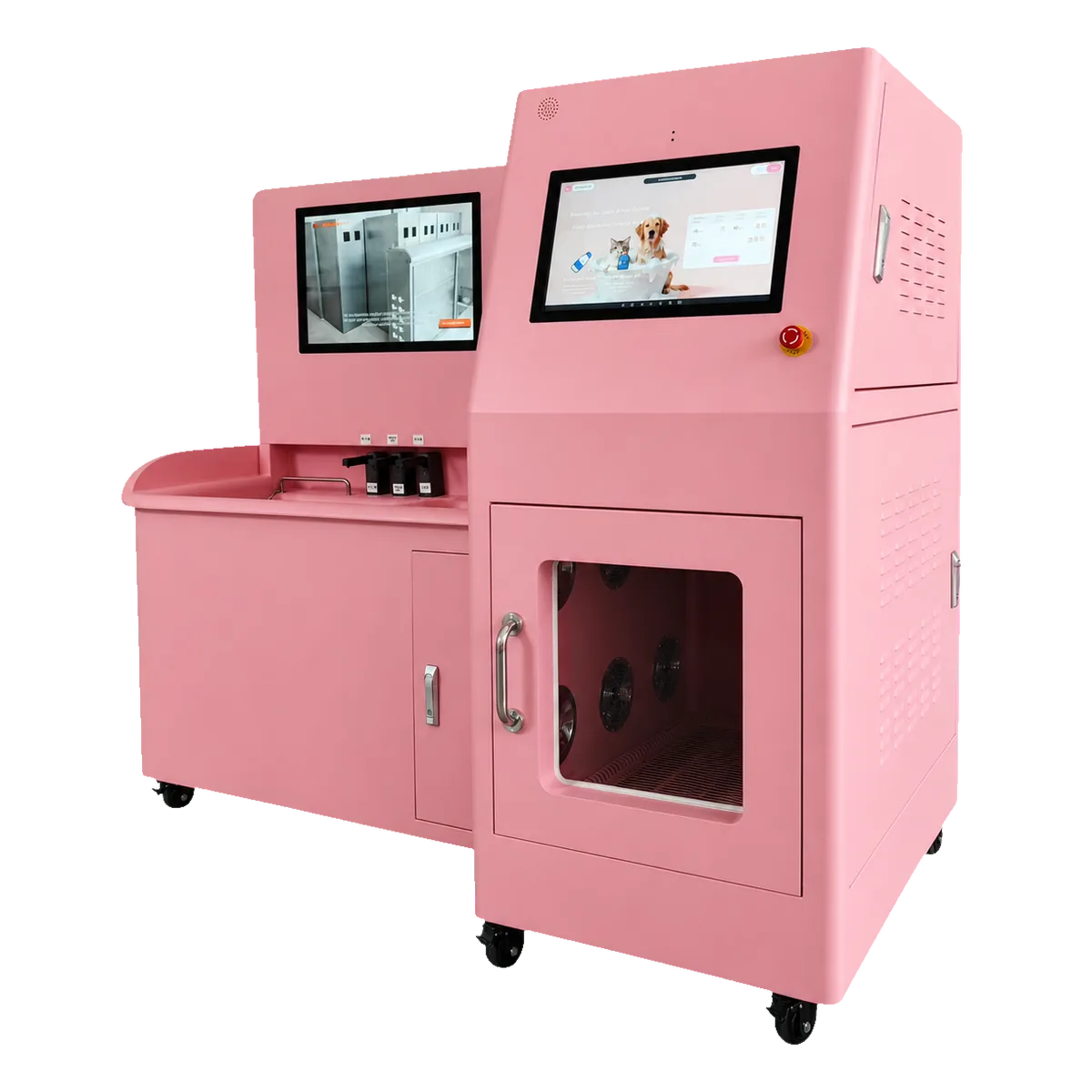
PetWash Tub
Indoor or outdoorFor a unit with someone behind the counter. Wash in the open bath, dry in the cabinet beside it, and let the 32-inch customer screen work as signage onto the walkway.
See the Tub →Certified for Export: CE, LVD, EMC & RoHS
You don’t have to worry about compliance. Every machine already meets CE, LVD, EMC, and RoHS standards, and we hand you the documents you need for customs, insurance, or your property manager.
CE certified
CE is the EU’s official conformity mark, and we include the certificates with your order for customs, insurers, and property managers.
LVD tested
LVD stands for the EU Low Voltage Directive, the electrical safety test that CE certification is built on. Tested to IEC 60335-2-75 with IEC 60335-1 — the standard written for commercial dispensing appliances.
EMC tested
It means the machine won’t cause electromagnetic interference with payment terminals or nearby equipment.
RoHS compliant
RoHS compliant means the machine is free of restricted hazardous substances, so it’s safe to import and operate. Assessed to EN IEC 63000:2018.
Where Else a Pet Wash Station Earns
Add the Pet Wash Amenity Your Leasing Team Can Sell
Country and quantity, and we can price it. A recommendation and the compliance documents your property team files come back within 24 hours.
- Factory-direct price, no middleman
- Amenity or kiosk-revenue models both supported
- Center branding on the cabinet
- Insurer paperwork included
No spam. Your details are used only to prepare your quote.
Pet Wash for Shopping Centers — FAQ
What property teams ask before adding one.
Why are shopping centers adding pet wash amenities?
Because pets pull traffic: 28% of owners bring their dog shopping (Rover), and 63% of US mayors surveyed say pet-friendly amenities attract additional retail traffic (ICSC). Dog-friendly centers are turning the dog from a reason to stay home into a reason to visit.
Where does a pet wash fit in a center?
Near the pet store or grocery anchor, by a concourse entrance, or in the parking field with the weatherproof PetWash Pro. It needs 1.2 m², water, a drain, and power — a kiosk footprint, not a tenant space.
Who operates the pet wash station — us or a tenant?
Either model works: the center runs it as an amenity/revenue kiosk, or your pet-store tenant operates it as a traffic driver. We support both, including your center’s branding on the cabinet.
Does a pet wash machine create mess or smell in the common area?
No — the cabin is sealed, disinfects itself with ozone, infrared, and UV-C after every pet, and traps hair internally. Wash water goes straight to the machine's own dedicated drain connection — nothing reaches your common-area floors.
What is the lead time on a pet wash machine order?
Production runs 25 business days from order confirmation. Centers normally align delivery with a fit-out window, and sea freight fits that timeline comfortably.
How much does a pet wash machine cost for a shopping center?
Most amenity spend on a footprint this small gets replaced in a few years. A pet wash sits on a longer curve: the cabinet keeps its finish outdoors for a decade, and we maintain it as long as you own it. Once we know your country and the number of units, pricing follows within one business day.
How much can a pet wash kiosk earn in a mall?
Published operator reports put a machine at 100–200 washes a month, or roughly $12,000–$24,000 a year at typical self-serve prices of $15–$25. One published report puts the average machine at about $17,000 a year, and another states $15,000 average annual profit per unit with a 12–24 month payback. On a 1.2 m² footprint that works out to roughly $900–$1,800 of gross revenue per square foot per year. Operating cost runs $1.20–$3.50 per wash. Your footfall and your price set the real number, which is why we model it from your actual traffic counts.
Is the pet wash machine safe if a stranger or a child uses it in the concourse?
Yes, and the design assumes exactly that. The cabin only runs with the door sealed. Millimeter-wave radar and infrared sensors watch the pet, and the door unlocks by itself if no vital signs show for 30 seconds. Water holds 38 °C and an NTC cutoff kills power above 42 °C. A physical stop button is on the panel, and the owner watches through the window the whole time. The CE (LVD + EMC) and RoHS certificates arrive with the machine, which is what your risk manager needs on file before opening day. Leasing can then market the amenity without a caveat. Run those systems together and injury moves from a live risk to a remote one.
Does a pet wash station need a wastewater permit or a special drain?
Usually far less than a build-out, but check your city — typically a business-license update and a plumbing sign-off. The machine collects hair and waste water internally on every cycle instead of flushing them into your common-area drains, which is what keeps the plumbing conversation short. Hair in floor drains is the number-one reported failure with open tubs. We supply the spec sheets and the CE / RoHS documents your inspector, plumber, or insurer asks for.
How much work is a pet wash station for our housekeeping team?
Almost none. Open tubs need somebody to scrub and rinse after every single pet — that is the loudest complaint on operator forums, and it is why tub sites end up needing constant attendance. Our cabin disinfects itself for 4 minutes with ozone, infrared, and UV-C after every wash, killing 99.9% of germs, and traps the hair inside. Someone refills shampoo and empties the hair trap on a normal round. No wet room to mop, no attendant to roster.
What happens if the pet wash machine breaks and you are on the other side of the world?
You film the fault on a phone. Our engineers diagnose it on a live video call, then ship the replacement part free with fitting instructions for your maintenance tech. Software problems are fixed remotely. Cover is 1 year on the whole machine, with lifetime maintenance after that. We have run our own pet wash stores for over 10 years, so the fault list is short and familiar to us.