You have picked the machine. You have run the numbers. Then somebody asks where the dirty water goes, and the project sits still for three months.
Most pet wash sites need a wastewater or trade-waste approval, because sewer authorities often class pet wash water as industrial rather than domestic. The rest is local detail, and one phone call gets you most of it.
The short version
- Pet wash water is dirtier than household water. Many sewer authorities class it as industrial.
- Septic systems are not built for it. On a septic site you will usually need a sealed holding tank.
- Hair is what inspectors worry about. Ask whether your authority wants an interceptor on the line.
- Ask your sewer authority before you sign a lease or place an order. The questions are listed below.
Here is what to ask, in the order a city asks it.
Why Pet Wash Waste Water Is Not Household Water
A shower at home sends soap and skin into the sewer. A pet wash sends something else.
King County’s environmental health department lists what pet business waste water actually carries: feces, litter, hair, cleaners, disinfectants, and flea and tick treatment residues. Its conclusion is direct. This waste water “differs greatly from household wastewater”, and it cannot be dumped onto the ground, into surface water, or into any other drain.
That last part matters. It rules out the yard, the storm drain and the parking lot gully. The water has to go somewhere approved.
It also explains why the answer changes between towns. Domestic water follows one broad rule. Industrial water is decided address by address, by whoever runs your sewer.
Which Permits a Pet Wash Station Usually Needs
There are normally four separate approvals. They come from different offices, and one being fine does not mean the next one is.
Business license. Standard for any business. Rarely a problem.
Zoning approval. Does your address allow animal services? Some zones treat pet care differently from retail. An outdoor machine on a forecourt can raise questions an indoor one does not.
Wastewater or trade-waste approval. This is the one that catches people. If your authority classes the discharge as industrial, you need a discharge permit. Los Angeles County Sanitation Districts state that businesses discharging industrial wastewater to the sewer must first obtain an Industrial Wastewater Discharge Permit. Businesses discharging only domestic wastewater may be exempt.
Building or works approval. Only if you are building something. A machine on an existing slab often needs nothing. A new room usually does.
Two practical notes. Discharge permits normally have to be in place before you start discharging, not after. And the permit itself can carry conditions: discharge volume, flow rate, waste strength, plus sampling, recordkeeping and reporting duties. Read those conditions before you sign. They are ongoing work, not a one-off form.
Where the Water Goes: Sewer, Septic or Holding Tank
Three situations. The cost gap between them is wide.
On public sewer. The simplest case. You connect to an existing line. You may need a discharge permit, and possibly an interceptor. Most urban and suburban sites land here.
On septic. The hard case. Commercial wash water is not allowed into a residential septic system. Pet waste is also outside what a septic field is built to break down. The usual answer is a sealed holding tank, emptied by a licensed hauler. That is a real running cost. Get a price per pump-out before you commit.
Outdoors on a forecourt or yard. Watch for stormwater rules. Many authorities require wash water to be kept separate from surface drainage. Your machine will need a dedicated drain, not the nearest gully.
Whichever applies, bring numbers. Our cabins use 0.09–0.11 m³ per wash. That is 90 to 110 liters, or about 24 to 29 US gallons. Ten washes a day is roughly 1 m³ a day. Permit tiers are often written around volume, so a real figure gets you a real answer.
Why Pet Hair Is the Part of a Pet Wash Drain That Fails First
Ask anyone running an open tub what goes wrong. Almost all of them say the same thing: hair in the drain.
Hair mats with soap and forms a plug that a plunger will not shift. Operators on car wash owner forums describe the same cycle: clear the trap, clear it again, then call someone with a jetter. It is the single most reported failure in self-serve pet washing.
Your sewer authority has the same worry, one scale up. Solids in the main are its problem, which is why interceptors get written into permits.
This is where a sealed cabin genuinely differs from a tub. In our machines, fur is caught by an internal filter on every cycle and collected inside the machine. Only filtered water reaches your drain line. You empty the filter as part of routine maintenance instead of unblocking a pipe.
The hair does not disappear either way. It gets caught somewhere you can reach, or it travels to somewhere you cannot.
7 Questions to Ask Your City Before You Buy a Pet Wash Machine
Print this. One call to the sewer or environmental health department usually covers all seven.
- Do you class a pet wash as industrial or domestic discharge at this address? Everything else follows from this answer.
- If industrial, do I need a discharge permit — and what does it cost per year? Ask about renewal fees and reporting duties, not just the application.
- Is this address on public sewer or septic? If septic, ask directly whether a holding tank is required and what capacity.
- Do you require a hair or lint interceptor before the drain connection? If yes, ask for the specification in writing.
- Is there a discharge volume that changes my permit tier? Give them your real figure: roughly 100 liters per wash.
- Does zoning at this address allow animal services, indoors and outdoors? Ask about both, even if you only plan one.
- If the machine stands outside, are there stormwater separation rules? Outdoor sites often have conditions indoor ones never see.
Write the answers down with the date and the name of the person who gave them. If a question comes back later, that note is worth more than your memory of the call.
What a Sealed Pet Wash Cabin Changes About Permitting
It does not make permits go away. Anyone who tells you otherwise is selling.
What it changes is the size of the build. A tub-based wash room needs a wet room: waterproofing, ventilation, floor drainage, and a way to stop the whole space smelling. That is construction, and construction is what triggers building approvals.
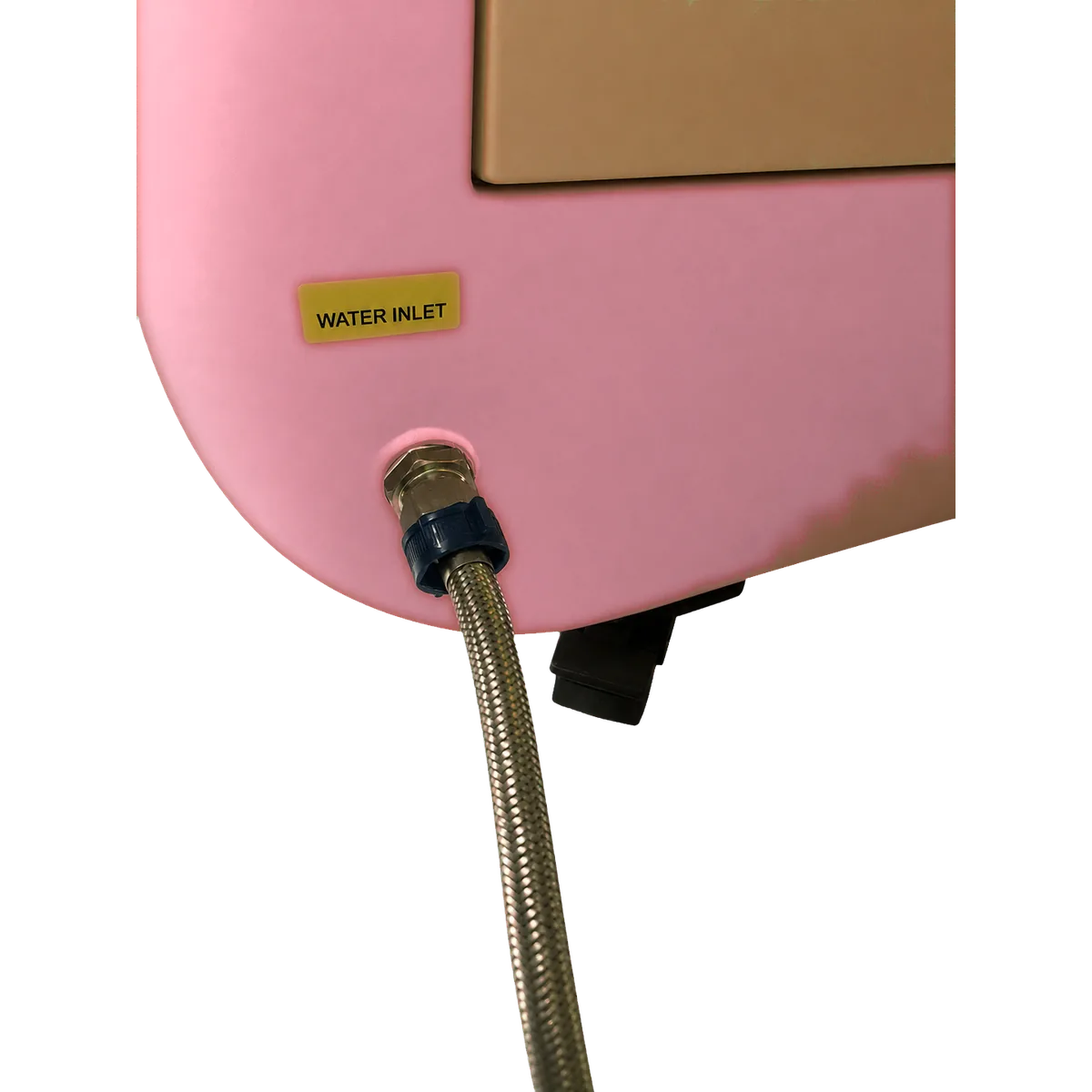
A sealed cabin is a connection job instead. It needs a level pad, water, a drain and power. The wash happens inside a closed steel box, so there is no wet room to build and no room to ventilate.
Two more things follow from that. Fur is captured inside rather than flushed into your lines, which answers the question inspectors ask most. And because the cabinet is weatherproof steel rated from −10 °C to 55 °C, you can put it outside and skip the interior works entirely. A canopy is available if you want the shelter for the customer rather than the machine.
Utilities and Space a Pet Wash Machine Needs on Site
Rough figures to check feasibility before you go any further.
| What | Figure |
|---|---|
| Footprint, flagship cabin | 1000 × 1190 mm (about 1.2 m²) |
| Footprint, in-store model | 1200 × 780 mm — 780 mm wide, for an aisle or corner |
| Footprint, compact model | 750 × 800 mm (0.6 m²), indoor only |
| Power | 4300 W, at 220–240 V or 110–120 V, whichever your country uses |
| Electricity per wash | 2–2.5 kWh |
| Water per wash | 0.09–0.11 m³ (90–110 liters) |
| Water pressure | 0.1–0.5 MPa, adjustable |
| Weight | 366 kg flagship · 298 kg in-store · 81 kg compact |
| Operating range | −10 °C to 55 °C |
Weight is the one you are most likely to forget. Check the floor loading before you plan an upper-floor install, and add the pet and the water in the system to the machine weight.
What Documents to Ask Your Pet Wash Supplier For
You will be asked for paperwork by more people than you expect: the permit officer, your insurer, possibly your landlord, and customs on arrival.
Ask for these before you order, not after:
- A dimensioned drawing with the service connection points marked.
- The water and power schedule, and the per-wash consumption figures.
- CE certification covering LVD and EMC, plus RoHS.
- A written description of how waste water and hair are handled.
If a supplier cannot produce these quickly, treat it as information about the supplier. We send the full pack on request while you are still deciding. A buyer who cannot get a permit is no use to either of us.
Start With the Drain, Not the Machine
The order that works is sewer authority first, zoning second, site survey third, machine last.
It feels like the slow way round. The operators who lose three months are the ones who bought the machine first.