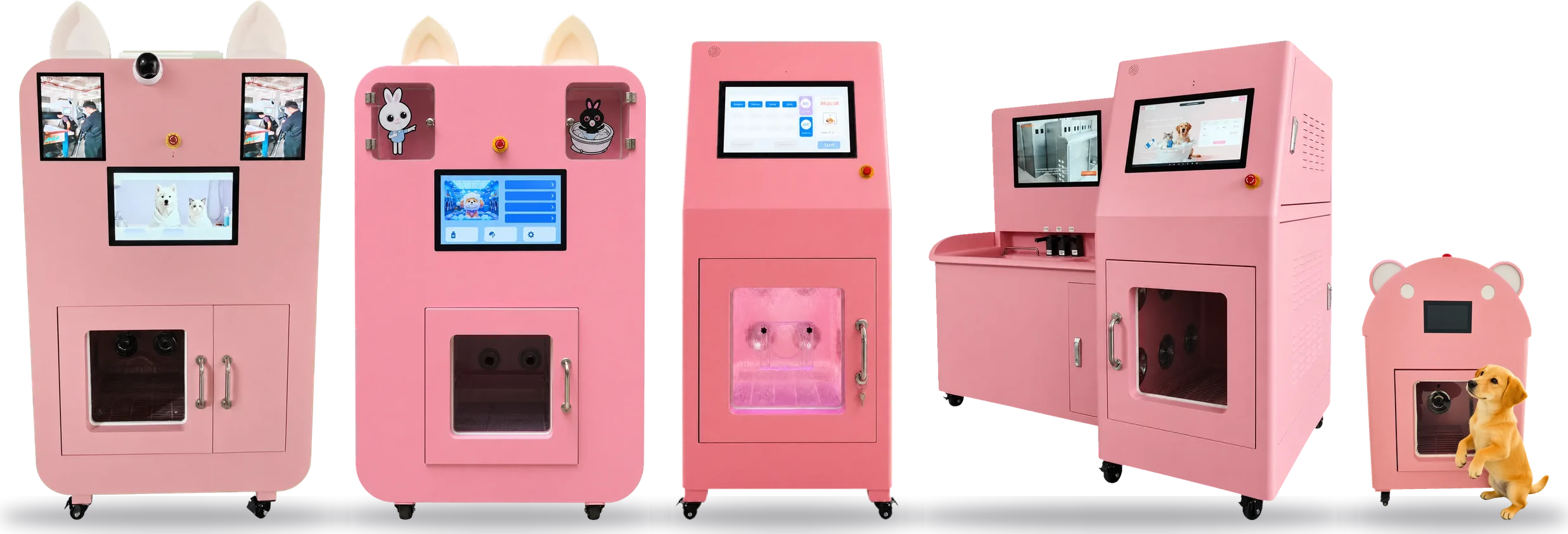
Thinking about adding a pet wash to your business for the extra income? But stuck on whether to buy the sealed automatic machine or the open self-serve tub?
Or has a supplier already told you which one to pick? Most of them build only one format, so their answer was decided before you asked.
Both are worth asking. The answer is shorter than you expect. Choose the sealed automatic pet wash machine if no staff is on site between washes. Choose the open self-serve dog wash tub if somebody already is. Staffing settles it for most buyers. Hygiene, space and ROI all follow from that.
We build both machines and we ship both. Nothing here is steering you toward the dearer one.
The short version
The sealed machine washes, rinses, dries and disinfects on its own, behind a closed door. The open tub hands your customer a shower and hands you the cleanup. Buy the format that matches your staffing, not the one that photographs better.
What Is a Sealed Automatic Pet Wash Machine?
It is a closed cabin that washes the pet for you.
Your customer walks the dog in, shuts the door, taps a card and picks a package. The machine runs a seven-step cycle. Clean-water pre-rinse, shower gel, rinse, shampoo, rinse, conditioner, final rinse. Then warm air dries the coat. PID control keeps the water at 38 °C ± 2 °C. The dryer works at 65 dB or less.
The owner waits outside and watches through the window. They leave dry. First-time customers notice that before they notice anything else.
Between animals the cabin cleans itself. Ozone, infrared and UV-C run for four minutes and kill 99.9% of germs. The fur ends up in an internal filter, not on your floor and not in your drain grate.
Most machines in this category are fully enclosed, and a few are semi-enclosed with a partial top. Ours close completely, because containment is the whole reason the format works. Nothing splashes out. No wet room, no mop, no fur on your tiles.
That is why these cabins suit sites that run unattended. Car wash forecourts. Laundromats. Apartment communities. Truck stops. Campgrounds. Pet stores that want the wash earning after the counter closes.
Ours take dogs and cats up to 70 kg (154 lb). They stand indoors or outdoors in weatherproof steel, from −10 °C to 55 °C. Payment is a Nayax terminal, so card, coin, tap and phone all work.
What Is an Open Self-Serve Dog Wash Tub?
It is an open bath station with the shower in a person’s hand.
No door, no fixed cycle. Your customer lifts the pet onto the grate floor, picks a package on the screen, and works a hand-held shower over the coat. Shampoo goes exactly where they decide. A dryer hose hangs on the tub wall beside the shower head, so the same person dries the pet without moving it.
There is also a drying cabinet beside the tub. That is the second, optional way to dry, for the customer who would rather not hold a dryer. The pet dries alone at 65 dB or less while the tub takes the next animal.
Hands-on control is the whole point of this format. Some coats need it. Think of a matted spaniel, a belly caked in mud, or a medicated shampoo that has to sit on one patch of skin. A fixed program cannot do any of that.
The tub also runs a package family the cabins do not have. Soak baths, around 60 minutes for a large pet and 30 minutes for a small one. Vets and groomers use them for skin conditions, where standing in water is the treatment.
So this format goes where hands are already on the floor. Grooming salons. Veterinary clinics. Pet stores. Boarding kennels. Any staffed wash bay.
The limits match the cabins: 70 kg (154 lb), and −10 °C to 55 °C indoors or outdoors. It carries the same Nayax terminal. It measures 630 mm across and 1960 mm end to end. That shape wants a wall to run along, not a corner to sit in. It is also the only model with two screens, a 21.5-inch main plus a 32-inch display. That is a lot of screen in front of somebody standing still for twenty minutes.
Which Pet Wash Equipment Fits Your Business Model?
Six questions decide it. Here is the whole comparison first, then each one in detail.
| What you are deciding | Sealed automatic machine | Open self-serve tub |
|---|---|---|
| Runs with nobody on site | ✓ | ✕ Needs someone between customers |
| Staff time per wash | ✓ None | ✕ Rinse the tub, clear the grate |
| Disinfects itself between animals | ✓ 4-minute ozone, infrared, UV-C | ✕ Done by hand |
| Keeps fur out of your drain line | ✓ Internal filter every cycle | ✕ Fur reaches the grate |
| Customer stays dry | ✓ Wash happens behind a closed door | ✕ Expect to get wet |
| Wet room needed indoors | ✓ No — nothing splashes out | ✕ Usually, or site it outdoors |
| Suits pets that refuse a closed door | ✕ | ✓ Open air, owner's hands on the pet |
| Soak and medicated bath programs | ✕ Wash and dry only | ✓ 60 min large, 30 min small |
| Customer aims the water where they want | ✕ Fixed program | ✓ Hand shower, any spot |
| Upfront cost | Higher | Lower |
| Labor cost per year | Lower | Higher |
| Maximum pet weight | 70 kg (154 lb) | 70 kg (154 lb) — the same |
| Card, coin and phone payment | ✓ Nayax terminal | ✓ Nayax terminal |
| Indoor or outdoor | ✓ Both, −10 °C to 55 °C | ✓ Both, −10 °C to 55 °C |
Both formats take pets up to 70 kg. If a supplier tells you their open tub handles heavier animals than a cabin does, ask for that number in writing.
Self-Service vs Staffed Operation
Ask yourself one thing. When a customer pulls in at 8 p.m. on a Tuesday, who is in the building?
If the honest answer is no one, you need the sealed machine. It takes the payment, runs the wash, dries the pet, and cleans up after itself before the next one arrives. Your site earns while it is closed.
If the answer is a groomer, a counter assistant or a store manager, the tub becomes a serious option. It assumes somebody is around. On a staffed site, that assumption costs you nothing.
Be honest about the middle case. “There is usually someone here” is not the same as “there is always someone here”. The tub gets dirty on exactly the shifts nobody is covering.
Labor and Staffing Requirements
The sealed machine takes washing off your payroll. Nobody lifts a dog, holds a hose, or stands there for twenty minutes. Once a week you empty the fur filter and top up the shampoo. That is the job.
The tub does not remove that work. It hands most of it to your customer and leaves a piece with you. Somebody rinses the tub between customers. Somebody clears the grate. Somebody shows the first-timer which button starts the water.
On a staffed site that is a few minutes between other jobs. On an unstaffed site it is a person you have to hire, and the machine stops paying for itself.
This is why the two formats split by venue. A laundromat, a car wash, an apartment community or a truck stop is buying income without a job attached. A grooming salon is buying a better tub for people who are already on the clock.
Hygiene and Cleanup Workload
Watch an open tub through a Saturday. The first dog leaves it fine. By the third, fur is stuck to wet steel and soap film has dulled the surface. Your fourth customer sees that before they see your price list.
That is the physics of an open format, and our tub is no exception. Fur travels to the grate and then toward your drain line. A wet floor means a mop. Wet-dog smell settles into a room unless the room moves air.
The sealed machine handles this differently because it has to. It was designed for sites with no one watching it. So disinfection is a four-minute step in the program, not a chore on anyone’s list. The fur it lifts off the coat lands in a filter rather than a grate.
So compare four things when you shortlist.
- Where the fur ends up. An internal filter, or your drain line.
- Who does the disinfection. The machine, or a person with a cloth.
- How often the surface needs wiping. Once a week, or between every customer.
- Where the odor stays. Inside the machine, or in your room.
Customer Experience and Ease of Use
Your customer sizes up the machine before they read a word on it.
A sealed cabin looks clean and modern. It also looks unfamiliar. A first-timer needs to see their dog through the window and understand that the door opens. Give them that and they relax. Hide it and they walk back to the car.
An open tub looks familiar. Everyone has washed a dog with a hose. There is nothing to explain, which is why hands-on owners pick it without hesitating.
Then there is what the pet thinks. Noise frightens animals far more than water does. A hand-held force dryer can run past 100 dB. Both of our formats dry at 65 dB or less, and the cabin puts a quiet closed box around the animal on top of that.
Five things move your repeat rate. Can the owner see the pet? Is the first screen obvious? How loud is the drying? How fast is the payment? Does the pet come out calm? Score both formats on those five, for your customers rather than customers in general.
Space, Installation, and Site Planning
Both formats need the same four connections. Power, water in, water out, and a payment signal. Voltage is 220–240 V or 110–120 V, whichever your country uses. Both carry CE (LVD + EMC) and RoHS.
The difference is the space around them.
A sealed machine needs a footprint and nothing more. Our flagship is 1190 mm wide and 1000 mm deep. The in-store model is only 780 mm wide, which is why it fits an aisle. Nothing splashes out, so the tile beside it stays dry and no wet room is required.
A tub needs a zone, not a footprint. Start with the machine, which is narrow but long enough to want a wall. Then add the space where the owner stands and gets wet. Add the space where the pet shakes. Add a floor that drains. Indoors that usually means building a wet room, unless you put the tub outside instead.
Walk your floor plan before you choose. Mark where a wet customer walks after the wash, and mark how you reach the back of the machine for service. Those two lines settle more layouts than machine size does.
Cost and ROI Expectations
The sealed machine costs more to buy, and it should. There is a full automation stack, a disinfection system and a dryer inside a weatherproof steel cabinet. The tub carries less of that hardware, so it is the cheaper way into the category.
Then the running years reverse the order.
Published operator reports put a self-serve wash at $15 to $25 a ticket. A working site does 100 to 200 washes a month. Operating cost lands around $1.20 to $3.50 per wash. Those figures are similar for both formats, because your customer pays the same for a clean dog either way.
Labor is what separates them. Ten minutes of staff time per wash, at 150 washes a month, is 25 hours a month. Price those hours at your own wage and you have the real gap between the two machines. On an unstaffed site the gap is wider, because the tub needs a person who does not currently exist.
So run your numbers on five inputs, not one.
- Washes per month at your site
- Your price per wash
- Staff minutes per wash, times your wage
- Maintenance and consumables
- How many customers come back within six weeks
Put our quote next to the yearly figure those five produce, and your payback window is one division.
When Should You Choose a Sealed Automatic Pet Wash Station?
Pick the sealed cabin if most of these describe your site.
The sealed cabin is your machine when
- No staff covers the hours between washes. Evenings, weekends, or the whole operation.
- You want the income without adding a job. The machine is the staff.
- Water, fur and odor have to stay put. The wash never touches the floor your other customers walk on.
- Most customers will be first-timers. A fixed program gives the same result whoever holds the lead.
- You run a car wash, laundromat, apartment community, truck stop, campground, shopping centre or pet store. Traffic you already have, earning twice.
- You want the wash to look modern. A lit cabin with a window sells itself from across a forecourt.
One reason people miss: a sealed machine gives the same wash on a Sunday night as on a Monday morning. That consistency is what turns a first wash into a booking every six weeks.
When Should You Choose an Open Self-Serve Dog Wash Tub?
Now the other way round. Recognise your site in this list and the tub is your machine.
The tub earns its space when
- Somebody is already on the floor. A groomer, a counter, a store assistant.
- You groom, treat or board animals. Coat checks, medicated shampoo and skin conditions all need hands.
- You need soak baths. No cabin runs them. The tub is the only model in our range that does.
- Your animals include the ones that refuse a closed door. Those pets should never go in a cabin.
- Your customers want to do it themselves. Plenty of owners want the hose in their own hand, just not in their own bathroom.
- You have room for splash, drying and cleanup. Or you put the tub outdoors and skip the wet room entirely.
The tub also carries less hardware, which makes it the lower-cost way to find out whether your site wants a pet wash at all.
What to Consider Before Choosing Between a Sealed Automatic Pet Wash Machine and an Open Self-Serve Dog Wash Tub
Answer these nine in order. Send us your answers and we will tell you which format we would put in your building, including when the answer is the cheaper machine.
- Self-service or staffed? Unattended points straight at the cabin. Staffed leaves both open.
- How many staff minutes can you give one wash? Under five, and an open tub will hurt.
- How much do water, fur and odor need to stay contained? A shared retail floor answers this for you.
- Do you need disinfection between animals? The cabin does it in four minutes on its own. A tub needs a person.
- What pet sizes will you serve? Both formats stop at 70 kg (154 lb). Cats and small dogs under 15 kg have a compact model of their own.
- What does the site already have? Power, water in, a drain, and floor space around the machine.
- Do you need card, coin and phone payment? Both formats carry a Nayax terminal, and pricing is set from the backend.
- How many washes a day do you expect? Low volume forgives a tub. High volume punishes anything a person has to reset.
- What happens when something breaks? Ask for the warranty in writing, and ask who ships the part.
On that last question, here is ours. One year on the whole machine, and maintenance for as long as you own the machine. When something goes wrong you send us a video. An engineer works out the cause with you on a call, then the part goes out free with fitting instructions.
We also run our own pet wash stores. The problems daily operation throws up are problems we handle ourselves every week. That is why we can usually name a fault on the first call.
Final Verdict: Sealed Automatic Pet Wash Machine or Open Self-Serve Dog Wash Tub?
Choose the sealed automatic pet wash machine if you want automation, containment and low labor. It earns from a site nobody is standing in.
Choose the open self-serve dog wash tub if you want hands-on control and soak programs. It suits a team that is already on the floor.
If you are staffed and busy, the real answer is often both. The cabin absorbs routine washing without occupying anybody. The tub picks up what a fixed program cannot. A frightened dog. An owner who wants the hose. A medicated soak. The two never chase the same customer, and one backend shows you what each of them earned.
Still on the fence? Ask for both quotes in one email and compare them side by side. We build both, so we have no reason to sell you the wrong one.