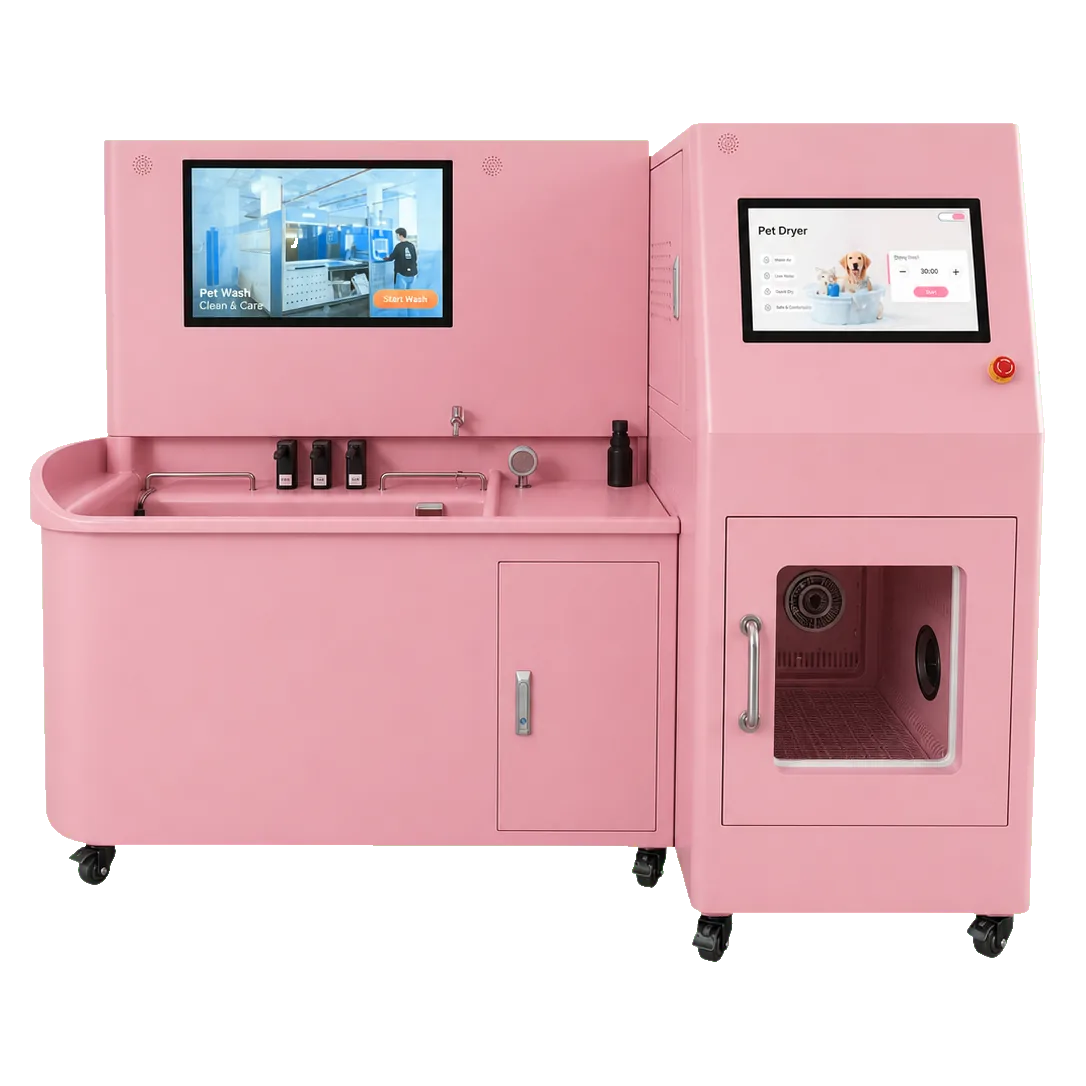
Thinking about opening a self-serve dog wash for the extra income? But worried you will spend the money and then watch the machine sit idle?
Or has the equipment question stalled you? Most suppliers build one format, so their advice was decided before you asked.
Both worries are reasonable, so here is the plain answer. A self-serve dog wash business earns when the site already has pet owners passing it, and the equipment runs without staff. Location and machine choice carry most of the result. Pricing, permits and cleaning follow from them.
We build the machines and we run our own wash stores. Here is the whole thing, step by step.
The short version
- Pick the site before the machine. Traffic you already pay rent on beats traffic you have to buy.
- A sealed automatic cabin runs unattended. An open tub needs somebody on the floor.
- Drainage and permits stall more projects than money does.
- Repeat use is the business. Dogs come back on a four-to-six-week cycle.
What Is a Self-Serve Dog Wash Business?
It is a business where your customer washes their own pet on your equipment.
You supply the station, the warm water, the shampoo and the dryer. Your customer supplies the labor. They pay at the machine, normally by card or phone, and they leave with a clean dog or cat.
A station that works in public needs all seven of these.
- A commercial wash station or a sealed automatic pet wash machine
- Warm water held at a safe, fixed temperature
- Shampoo and conditioner, dosed by the machine
- A dryer the animal will tolerate
- A drain connection and a hair filter
- A payment terminal that takes cards, coins, contactless and phone wallets
- Instructions a first-time customer can follow without help
The market offers two formats. In a sealed automatic pet wash machine, the pet goes behind a closed door and the machine does the work. At an open self-serve dog wash tub, the shower stays in a person’s hand from start to finish. Step 4 is where you choose, and our full comparison of the two formats goes deeper than this guide can.
Why Start a Self-Serve Dog Wash Business?
Because the demand comes back on a short cycle, and the work mostly does not.
The APPA reports that 53% of US households own a dog, with pet spending heading for $165B in 2026. The AKC puts most dogs on a bath every four to six weeks. So a customer you win in March is still washing with you in December.
Five things make the model attractive to first-time owners.
- Low labor. Nobody lifts a dog or holds a hose. Full-service grooming cannot say that.
- Repeat demand. A groom is a booking. A wash is a habit.
- It fits inside other businesses. A car wash, laundromat, pet store or apartment block can add one without changing what it does.
- It earns from traffic you already have. You are already paying rent for those customers.
- It answers a real problem. Plenty of owners will not bathe a muddy 30 kg (66 lb) dog in their own bathroom.
One more thing scales well. When every station runs the same equipment and the same programs, your second site is a copy of your first, not a new project.
Step 1: Choose Your Self-Serve Dog Wash Business Model
Two questions settle this. Where does the station live, and who is on site while it runs?
Start with where.
| What changes | Standalone dog wash site | Add-on inside your business |
|---|---|---|
| Rent for the floor space | ✕ A new lease | ✓ Space you already pay for |
| Where the first customers come from | ✕ You buy the traffic | ✓ People already walking past |
| Water, drain and power on site | ✕ Usually new work | ✓ Often already there |
| Opening hours | ✓ Yours to set | ✕ Tied to your hours, unless the machine stands outside |
| Control of the brand | ✓ The whole site is the wash | ✕ Shares the sign with everything else |
| Money at risk before the first wash | Higher | Lower |
| Sensible first order | One or two sealed cabins | One machine that fits your floor |
Then decide who is there. Staffed, part-staffed or unattended is not a detail, because it picks your equipment for you.
A sealed automatic cabin takes the payment, runs the cycle, dries the coat and disinfects itself. It can stand on a forecourt at midnight with nobody in the building. An open tub assumes a person nearby to rinse it between customers, so it belongs on a staffed floor.
Most first-time owners start as an add-on and move to a standalone site later. That order costs less to learn on, and the first site pays for the second.
Step 2: Research Your Local Market for a Self-Serve Dog Wash
You can do the whole check in one weekend. Answer these seven before you sign anything.
- Count dogs, not people. Walk your shortlisted area on a Saturday morning and count what goes past.
- Map who already washes them. Grooming salons, mobile groomers, vet clinics and any wash bay within a fifteen-minute drive.
- Call three groomers. Ask how far ahead they are booked. A two-week wait is demand you can take today.
- List the pet-friendly apartment blocks nearby. Residents with no bath big enough at home become your regulars.
- Find the dog parks, trails and beaches. Muddy dogs come off them in every season, and their owners want the mess handled before the car.
- Read the reviews of the nearest wash. The complaints tell you what to build, and they are usually about cleanliness and broken equipment.
- Check what your area pays. You need a price your customers accept before you can plan revenue.
Your customers will cluster into a few groups: apartment residents, owners of large dogs, dog-park regulars, busy professionals and multi-dog households. Cat owners are a smaller group, and almost nobody serves them. A quiet machine changes that.
Look for the gap rather than the competitor. No appointment needed, longer hours, a cleaner station and a price under the local groom are all gaps worth taking.
Step 3: Pick the Right Location for a Self-Serve Dog Wash
Site quality moves your wash count more than anything you do later. Judge each option on what you can see on the day you visit.
Good signs at a site
- Parking within a few steps of the machine. A wet dog does not walk far.
- Traffic that already includes pet owners, such as a pet store, car wash, laundromat or busy retail strip.
- Water, a drain and spare electrical capacity already on the wall.
- A dog park, trail or beach within a short drive.
- A spot where the machine is visible from the road.
- A landlord who will put the approval in writing.
Warning signs at a site
- No drain nearby, and a long trench to the closest one.
- A shared drain your landlord will not let you touch.
- A position where the machine cannot be seen from outside.
- Zoning that puts animal services in a category of their own.
- Electrical capacity already at its limit.
- Nowhere for a car to stop for twenty minutes.
Bring real utility numbers to every site visit. Our machines use 0.09–0.11 m³ of water per wash, which is 90 to 110 liters or 24 to 29 US gallons. Power draw is 2–2.5 kWh per wash, on 220–240 V or 110–120 V, whichever your country uses.
Outdoor siting solves a lot of these problems. Our cabinets are weatherproof steel, rated from −10 °C to 55 °C, so a level pad outside often beats a difficult room indoors. An optional canopy is available for an exposed site.
Step 4: Choose the Right Self-Serve Dog Wash Equipment
This is the decision you live with every day, so give it more time than the lease.
Format comes first, and staffing decides it. Nobody on site between washes points to a sealed automatic cabin. A staffed grooming or retail floor opens up the open tub. The tub also runs soak baths, which no cabin does: about an hour for a large pet, half that for a small one.
After that, put ten questions to every supplier on your shortlist. Each one has a number for an answer. A supplier who replies with an adjective is telling you something.
- What holds the water temperature? A dial is not an answer. Ours is PID controlled at 38 °C ± 2 °C, and a second sensor kills the power over 42 °C.
- What is the pressure range, in MPa? It has to lift dirt out of a coat without hurting skin. Ours is adjustable from 0.1 to 0.5 MPa.
- How many decibels does it dry at? Noise is what makes an animal refuse a second visit. Ours works at 65 dB or under. Salon force dryers often run past 100.
- How is shampoo dosed? By the program, and easy to refill. No added perfume, because scent sprays are toxic to cats.
- Where does the fur go? Fur is what fails first in this business. On ours it is trapped in a filter you pull out by hand.
- What runs between animals, and for how long? Ours takes four minutes and kills 99.9% of germs. Ozone, infrared and UV-C do the work.
- Which payments does the terminal take? Nayax handles the lot, from chip and coins to Apple Pay. Prices change remotely from the backend.
- What happens if the machine loses sight of the animal, or loses power? Radar and infrared watch the pet from start to finish. The door releases after 30 seconds with no signal, and the lock needs power to stay shut.
- Can you reach the filters and drains yourself? Anything that needs a technician will not get done weekly.
- What does the warranty say, in writing? Ours covers the whole machine for one year, and maintenance never runs out.
Which model suits which start:
- A forecourt, laundromat or any unattended site — the double-door flagship or the single-door cabin. Both stand indoors or outdoors and take pets up to 70 kg (154 lb).
- A shop aisle or a tight retail corner — the in-store model, only 780 mm wide.
- Cats and small dogs up to 15 kg (33 lb) — the compact model, indoor only.
- A staffed grooming or vet floor — the open self-serve tub, with a hand shower, a dryer hose beside it and soak packages.
Equipment choice sets your labor cost, your hygiene standard and how often customers come back. It is the one line of your budget that keeps charging you after you have paid for it.
Step 5: Estimate Your Self-Serve Dog Wash Startup Costs
Nobody can give you one honest number, because two sites with the same machine can land far apart. Build your budget from the lines below instead.
| Cost line | What decides its size |
|---|---|
| Equipment | Format, how many stations, and whether drying and payment are built in |
| Water in, waste out | Distance to a usable drain, and whether your authority wants an interceptor |
| Electrical work | Whether the site already has spare capacity for 2–2.5 kWh per wash |
| Site preparation | A level pad outdoors, or a wet room indoors if you choose an open tub |
| Payment and connectivity | The terminal, plus a SIM or wi-fi for remote pricing and reports |
| Permits and approvals | Local rules, with wastewater the one that bites |
| Insurance | General liability and property cover for the equipment |
| Signage and branding | The cheapest lever you have on wash volume |
| Supplies | Shampoo, conditioner and towels for the first months |
| Launch marketing | Listings, photos, opening offers |
| Maintenance fund | Filters, seals and the call-out you have not had yet |
Two lines catch people out. Drainage is one, because the trench and the approval are invisible until somebody asks where the water goes. Site preparation is the other, and an open tub indoors is where it grows, since splash and drying need a room that can get wet.
Running cost is easier to plan than setup cost. Operators who publish their figures land between $1.20 and $3.50 a wash, covering water, power, shampoo and routine maintenance.
We do not publish machine prices. Get two written quotes before you sign a lease. One for the equipment, one for the plumbing and electrical work. Those two numbers decide whether the site works.
Step 6: Permits, Insurance and Rules for a Dog Wash Business
Requirements vary by city and state, so treat this as the list of calls to make, not as legal advice.
- Business registration. Standard, and rarely the problem.
- Zoning or landlord approval. Some zones treat animal services differently from retail. Get the answer in writing.
- Wastewater or trade-waste approval. A wash sends far more hair, mud and shampoo down the line than a kitchen sink, which is why many authorities class it as trade waste. This is the approval that delays projects.
- Plumbing and building sign-off. Needed if you are building rather than connecting.
- Insurance. General liability plus property cover on the equipment. Tell your insurer that the machine holds water at a fixed temperature and carries an emergency stop.
- Posted customer rules. A short sign at the machine, covering which pets should not use it and what to do if something goes wrong.
Make the wastewater call before you sign anything. Our guide to pet wash permits, drains and waste water lists the seven questions your sewer authority will answer in one phone call.
Ask your equipment supplier for the paperwork early. Inspectors and insurers tend to want the same four documents. A machine drawing with real dimensions. A water and power schedule. Your consumption per wash. The CE (LVD + EMC) and RoHS certificates. We send all of it on request, before you order.
Step 7: Set Your Pricing and Revenue Model for a Self-Serve Dog Wash
Price against your local grooming salon, not against another self-serve wash. Your customer is comparing you with the professional groom they are trying to avoid. That averages $60 in the US, in a $30 to $90 range (Dogster industry data).
Four models are common, and most sites run more than one.
- Pay per wash. The simplest, and the easiest for a first-time customer to understand.
- Timed sessions. Priced by minutes, which suits a busy site with a queue.
- Packages. Wash and dry, or dry only. On our machines you set the packages yourself from the backend and change prices remotely.
- Memberships and multi-wash cards. These smooth out winter and lock in the regular.
For context, tickets across the trade sit in the $15 to $25 band, and a working machine turns 100 to 200 washes a month. Your price and your traffic matter about equally, so do not fix one and ignore the other.
Add-ons lift the average ticket without adding staff. Premium shampoo, a flea and tick wash, towels and brushes all sell well. So does a small shelf of retail beside the machine. Sell them on the screen, where the customer is already paying, rather than at a counter that may be closed.
Step 8: Plan Daily Operations for Your Pet Wash Station
Uptime and cleanliness are the whole operating job. Customers forgive a queue, but they do not come back to a dirty station.
| How often | What you do | Why it matters |
|---|---|---|
| Every day | Look inside the cabin, wipe the window and screen, run one cycle | Your first customer sees exactly what the last one left |
| Every week | Empty the hair filter, top up shampoo and conditioner, check the drain runs clear | Fur and residue are what turn into a call-out |
| Every month | Check water temperature and drying against the manual, test the emergency stop, read the payment report | Small faults show as slow cycles before they show as failures |
| Every quarter | Inspect seals and hoses, order spare consumables, review your busiest hours | Spares in a cupboard save days of downtime |
| Ongoing | Keep a dated maintenance log, answer every new review | The log settles disputes, and the reviews decide who tries you next |
None of this is a full-time job. On a sealed automatic machine the daily part is short, and the weekly check is the real one. The cabin disinfects itself between animals, so nobody follows customers around with a cloth.
Watch the payment terminal as closely as the plumbing. A machine that cannot take money is down, even when everything else works.
Step 9: Market Your Self-Serve Dog Wash Business
Start marketing three weeks before you open, not on the day. An empty station in week one is a hard thing to recover from.
- Google Business Profile. Set it up before opening, with real photos, real hours and the words “self-serve dog wash” in the description.
- Signage the road can read. A driver should know what the machine is without slowing down. This is the cheapest wash-volume lever you have.
- Two local partnerships. Pick from the nearest dog park, apartment managers, vets, shelters and groomers. Groomers will send you the plain wash-and-dry jobs they do not want.
- Short videos. One dog going through a full cycle answers more questions than any leaflet.
- A first-wash offer that earns a second visit. Half price on the next wash beats a free first wash, because it books the return.
- A membership at launch. Early sign-ups give you cash and a reason to come back.
- A review request at the machine. Ask on the screen while the dog is still drying and calm.
Step 10: Track the Numbers That Decide Your Dog Wash ROI
Seven numbers tell you everything. Our networked machines report most of them in the free management backend, which shows live status, revenue and wash counts per machine.
- Washes per day, per machine. Your headline number.
- Average ticket. Where add-ons and packages show up.
- Repeat rate within six weeks. The one that predicts next year, since that is the normal bath cycle.
- Membership sign-ups. Your protection against a quiet January.
- Utilities and supplies per wash. Hold it against the running-cost range in Step 5.
- Downtime hours. Every hour offline is a wash somebody bought elsewhere.
- Reviews and rating. Cheap to fix early, expensive to fix late.
Then act on what they tell you. Low volume with good reviews is a marketing and signage problem. Good volume with a low repeat rate is usually a cleanliness or drying problem. Falling revenue on a machine that is still busy means your pricing has drifted behind your area.
Is a Self-Serve Dog Wash Business Profitable?
Yes, when your wash volume, your rent and your labor line up. The arithmetic is short enough to do on paper.
Start with the gross. Take the ticket and the monthly volume from Step 7 and multiply. Reported figures put a working machine near $17,000 a year. Then take off the running cost from Step 5, plus rent, insurance, supplies and your own hours. What is left is your real number.
Where you start changes how fast you get there. An add-on inside an existing business reaches profit sooner, because the rent, the utilities and the customers are already paid for. A standalone site carries more overhead, and gives you the brand, the hours and the second location later.
Judge the equipment on total return, not on the sticker. A cheaper machine that needs staff, or that customers avoid after one bad wash, costs more every month you own it. Put our quote next to your yearly figure, and your payback window is one division.
Common Mistakes to Avoid When Starting a Self-Serve Dog Wash Business
The nine that cost the most
- Choosing the site on rent alone, then discovering nobody walks past it.
- Buying equipment on price alone, and paying for it in labor and complaints.
- Underestimating drainage, which is the single most common delay.
- Skipping the daily clean, because the fourth customer of the day sees the first three.
- Budgeting nothing for maintenance, then waiting two weeks for a part.
- Confusing controls at the machine, which turn first-timers into non-customers.
- Starting marketing on opening day instead of three weeks earlier.
- Tracking revenue but not repeat rate, so you never find out why regulars stopped coming.
- Ignoring cat owners, who are underserved and pay well for a quiet machine.
Your Self-Serve Dog Wash Business Checklist
Run through these before you place an order. Anything still open is a question worth answering first.
- Business model chosen. Standalone or add-on, staffed or unattended.
- Location validated. Pet-owner traffic, parking, visibility from the road.
- Utilities confirmed. Water in, drain out, electrical capacity, a floor that can get wet.
- Equipment compared. Format, temperature and noise figures, hygiene cycle, payment and warranty.
- Budget prepared. Machine, plumbing and electrical work, permits, launch and a maintenance fund.
- Permits and insurance checked with your own city and your own insurer.
- Pricing and packages set, against local grooming prices rather than guesswork.
- Cleaning and maintenance plan written down, with a named person for each task.
- Marketing live before opening day. Profile, signage, two partnerships.
- Supplier support confirmed. Warranty terms, spare parts, and how fast somebody answers.
Final Thoughts on Starting a Self-Serve Dog Wash Business
The model is not complicated. A site people already visit, a machine that runs without you, and a station that is clean at four in the afternoon.
Get the location and the equipment right and the rest is maintenance. Get the location wrong, or buy a machine that needs a person standing beside it, and no amount of marketing repairs it.
A self-serve dog wash works as a venture of its own, and it works bolted onto a shop or forecourt you already own. The second route is the cheaper way to find out what your area wants.
Whoever you buy from, make them put a figure behind every claim, and ask what happens the week something breaks. If you want a second opinion on your own site, send us the venue and the country. Sometimes our answer is the cheaper machine, and we will still say so.